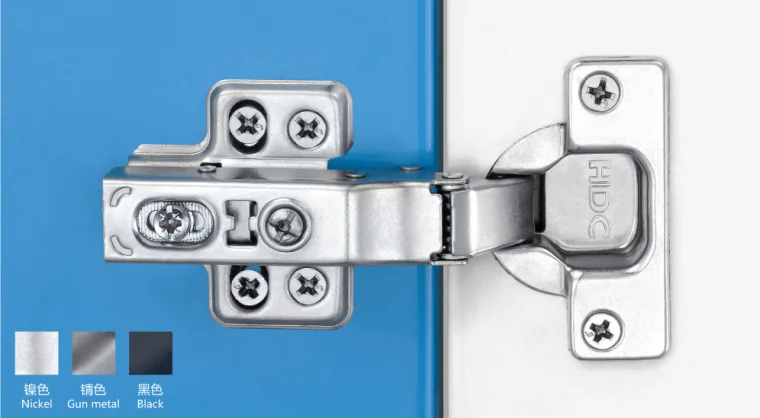
A 110 degree cabinet hinge is designed to provide practical door access in many kitchen cabinets, wardrobes, bathroom vanities, and storage units. Yet even a hinge with a suitable opening angle and finish can perform poorly if the door is incorrectly drilled, the mounting plate is mismatched, or the cabinet structure cannot maintain secure fastening. Uneven door gaps, loose screws, rubbing edges, and inconsistent closing behavior are often caused by the interaction between hardware selection, cabinet manufacturing, and installation quality rather than by a single defective component.
For furniture manufacturers, these problems have direct operational consequences. A small alignment error may be manageable on one cabinet, but repeated across hundreds of doors it can increase assembly time, generate rework, and lead to customer complaints after delivery. Choosing a suitable hinge and establishing a repeatable installation process are therefore closely connected decisions.
HDC, the main brand of Hong Deng Metal Products Co., Ltd., manufactures furniture hinges and related metal fittings. The company operates a factory covering more than 10,000 square meters, with a plating workshop occupying more than 1,000 square meters according to its company profile. Its manufacturing equipment includes CNC digital-control production equipment, wire-cutting machines, and an automatic plating production line. These capabilities are relevant to evaluating dimensional consistency and surface finishing in furniture hardware.
Why Correct Hinge Positioning Matters
A concealed 110 degree cabinet hinge connects the door to the cabinet through a cup fitted into the door and a mounting plate attached to the cabinet side. The relative position of these components determines how the door sits when closed and how it moves during opening. Small deviations in drilling position or mounting geometry can create visible alignment problems, even when the hinge itself is manufactured correctly.
The cup's distance from the door edge is particularly important. If the cup hole is drilled too close to or too far from the edge, the installed door may have the wrong overlay or insufficient clearance. The hinge may also operate outside its intended geometry, making adjustment more difficult. Excessive drilling depth can damage thin panels, while an oversized or poorly positioned hole can reduce the stability of the mounting screws.
The cabinet-side mounting plate must also be positioned according to the hinge specification. Its location affects door height, overlay, and depth. If the wrong mounting plate is used, or if the drilling pattern does not match the hardware, the door may sit too far forward or backward. Attempting to correct a major mismatch through hinge adjustment can leave the mechanism near the limit of its adjustment range and make future alignment more difficult.
For repeatable assembly, drilling templates and model-specific installation drawings should be used. Before production starts, a trial installation should verify the cup position, plate location, door clearance, and final alignment. This simple validation step helps identify dimensional conflicts before they affect a complete batch of furniture.
Preventing Uneven Gaps and Door Misalignment
Uneven gaps between cabinet doors are among the most visible signs of an installation problem. In a kitchen with multiple adjacent doors, even small differences in position can interrupt the visual alignment of the cabinet fronts. Misalignment may result from inconsistent drilling, an out-of-square cabinet carcass, door dimensional variation, incorrect hinge selection, or improper adjustment.
A 110 degree cabinet hinge with lateral adjustment can help correct side-to-side positioning, while depth adjustment can help bring the door face into line with adjacent panels. Height adjustment, where supported by the mounting arrangement, can correct vertical differences. However, the available range varies by model, so the adjustment mechanism should be checked before specifying the hinge.
Adjustment should follow a controlled sequence. First, verify that the cabinet carcass is square and securely assembled. Next, check that the hinge cups and mounting plates are correctly installed and that all fasteners are secure. Then adjust the door position gradually, checking the gap along the top, bottom, and side edges after each correction. This method is more reliable than making repeated uncoordinated adjustments to individual hinges.
If the door remains misaligned despite reasonable adjustment, inspect the underlying installation. A warped door, damaged mounting hole, loose carcass joint, or incompatible mounting plate cannot always be corrected through hinge adjustment. Identifying the cause prevents unnecessary hinge replacement and reduces the likelihood that the same issue will recur.
Door Weight, Hinge Quantity, and Fastener Reliability
The durability of a 110 degree cabinet hinge depends partly on the load transferred from the door through the hinge body and into the cabinet structure. Door weight is only one factor. A wide door creates greater leverage at the hinge mounting points, while thick panels, glass inserts, decorative surfaces, and integrated accessories may increase the total load or change its distribution.
The number and position of hinges should follow the manufacturer's recommendations for the specific door dimensions, weight, and material. Two hinges may be adequate for some small, lightweight doors, while taller or heavier doors may require additional support. There is no universal hinge-count rule that safely covers every cabinet design, so the selected configuration should be verified against the product's technical guidance.
Fastener retention is equally important. Even a robust hinge can become loose if the screws are unsuitable for the substrate or installed into damaged holes. Particleboard, MDF, plywood, and solid wood have different fastening characteristics, and the required screw type and engagement depth should be appropriate for the door or cabinet material. Repeated adjustment or overtightening can also damage mounting points, reducing their ability to hold the hardware securely.
When a hinge becomes loose during service, replacing the hinge alone may not solve the problem. The mounting holes, screw condition, cabinet panel, and hinge geometry should be inspected to determine whether the root cause is fastener failure, material damage, or excessive loading. Where the panel is damaged, the repair method must restore secure attachment rather than simply reuse an unstable fixing point.
For furniture produced at scale, verifying the hinge configuration during prototype assembly can prevent recurring load-related issues. It is also useful to document the approved hinge count, screw specification, installation torque where specified, and mounting positions in the assembly process.
Understanding Closing Behavior and Adjustment Stability
A cabinet hinge's opening angle does not fully describe its closing behavior. Depending on the model, a 110 degree cabinet hinge may incorporate a spring mechanism, a soft-close damper, or another closing feature. These functions should be confirmed from the product specification rather than assumed from the opening-angle designation.
Spring-assisted hinges use mechanical force to help return the door toward its closed position. Soft-close designs generally use a damping mechanism to reduce the speed of the final closing movement. These features address different aspects of door operation, although some products combine them in one assembly. The correct choice depends on the furniture design, desired user experience, and compatibility with the cabinet door.
A soft-close hinge should not be expected to compensate for a badly aligned door or excessive mechanical resistance. If the door rubs against the cabinet, the damping mechanism may not operate as intended. Similarly, a door that is too heavy for the specified hinge configuration may close inconsistently even if the damper functions correctly under lighter test conditions.
Adjustment stability matters after installation. If screws loosen or the mounting interface shifts during repeated use, the door position can change and create uneven gaps or rubbing. A reliable assembly requires secure fastening, compatible hardware, and adjustment within the manufacturer's specified range.
During sample validation, test the door through its complete movement rather than checking only whether it closes once. Observe whether the door moves freely, whether adjacent doors interfere, whether the closing action is consistent, and whether the final position remains stable after repeated cycles. These checks can reveal issues that a visual inspection of the closed cabinet may miss.
Corrosion Testing and Finish Quality
Cabinet hardware is often exposed to humidity, condensation, fingerprints, and cleaning products. In kitchens and bathrooms, these conditions can challenge the surface finish and eventually affect appearance or mechanical performance. Corrosion resistance should therefore be considered during hinge selection, especially for furniture intended for humid environments or long service intervals.
A hinge's finish is influenced by the substrate material, surface preparation, plating or coating process, and quality control. Differences in these factors can affect coating coverage, adhesion, appearance, and resistance to corrosion. Consistency is particularly important when multiple hinges are visible or when a furniture range uses a specified hardware finish across many cabinets.
HDC reports that its products have passed a 48-hour salt spray test. This provides a useful starting point when assessing the company's stated corrosion-testing capability. However, a salt spray duration should not be interpreted as a direct prediction of years of real-world service. The test standard, specimen preparation, evaluation criteria, and specific product tested must be understood before results can be compared fairly.
For a production order, request confirmation that the test results apply to the intended hinge model and finish. If the project has specific corrosion-resistance requirements, agree on the applicable testing method and acceptance criteria before mass production. Sample inspection can also help verify finish consistency, surface defects, and the appearance of the final hardware.
The reported 48-hour salt spray result should be considered alongside other performance factors, including cycle testing, fastening reliability, and dimensional consistency. A corrosion-resistant finish cannot compensate for an incompatible hinge configuration or a weak mounting interface.
How to Evaluate Hinge Durability Before Mass Production
Cycle-life testing provides evidence of how a hinge performs under repeated operation, but the result is meaningful only when the test conditions are understood. HDC reports opening-and-closing testing exceeding 80,000 cycles, as well as testing against the national product quality standard QB/T 2189-1995. For technical evaluation, the applicable test records, product model, loading conditions, and pass criteria should be confirmed.
A cycle test typically evaluates repeated opening and closing under defined conditions. Actual service life may differ because real cabinets experience different door weights, opening speeds, impact forces, mounting quality, environmental exposure, and user behavior. A hinge installed correctly on a suitable door may perform differently from the same hinge installed on a heavy door with inadequate fasteners.
A useful validation process combines supplier test data with application-specific sample testing. Install the proposed hinge on a representative cabinet using the intended door material, mounting plate, drilling pattern, and screw type. Confirm the door's opening clearance, overlay, adjustment range, closing behavior, and fastening stability. For demanding applications, test the assembly under a representative operating cycle and inspect for looseness, deformation, wear, and changes in alignment.
It is also important to compare suppliers using consistent criteria. One manufacturer may quote a cycle count without describing the load or test setup, while another may provide more detailed documentation. A higher number alone does not necessarily establish superior performance if the testing methods are different.
Manufacturing Consistency and OEM Requirements
For large furniture production runs, a hinge must do more than perform well in a single sample. Dimensional consistency between batches affects the repeatability of drilling, assembly, adjustment, and final appearance. Variations in cup geometry, mounting dimensions, hinge movement, or surface treatment can lead to differences between cabinets assembled on the same production line.
A supplier evaluation should therefore cover technical documentation and manufacturing controls. Confirm the hinge drawing, key dimensions, compatible mounting plates, material and finish specifications, adjustment features, and available performance test records. If the project uses a customized configuration, the approved sample and drawing should define the reference for subsequent production.
Hong Deng Metal Products Co., Ltd., under its HDC brand, focuses on the research, production, and sales of furniture hinges and related metal fittings. Its reported manufacturing facilities include CNC digital-control production equipment, wire-cutting equipment, and an automatic plating production line. The company also reports a factory area exceeding 10,000 square meters and a plating workshop of more than 1,000 square meters. These capabilities provide useful context when evaluating manufacturing scale and finishing arrangements, although project-specific quality requirements should still be confirmed directly.
For OEM projects, communicate the cabinet construction, door dimensions and weight, required opening angle, overlay type, finish, expected operating conditions, and any special packaging or labeling requirements. Agreeing on specifications before production helps reduce ambiguity and supports consistent deliveries.
Conclusion
Reliable performance from a 110 degree cabinet hinge depends on the entire installation system, including door geometry, drilling accuracy, mounting plate compatibility, hinge quantity, fastener retention, closing behavior, and surface durability. The opening angle is an important specification, but it cannot compensate for incorrect mounting or an unsuitable load configuration.
A structured validation process helps identify problems before mass production. Confirm the technical drawing, install a representative sample, verify alignment and movement, and review cycle-life and corrosion-test evidence under clearly defined conditions. For furniture manufacturers seeking consistent concealed hinge solutions, HDC offers furniture hardware backed by reported testing and established metal-processing capabilities. Matching the selected hinge to the real cabinet application is the foundation for reliable operation, consistent appearance, and lower long-term maintenance costs.
www.hdcprec.com
Hong Deng metal products Co., LTD
About Author