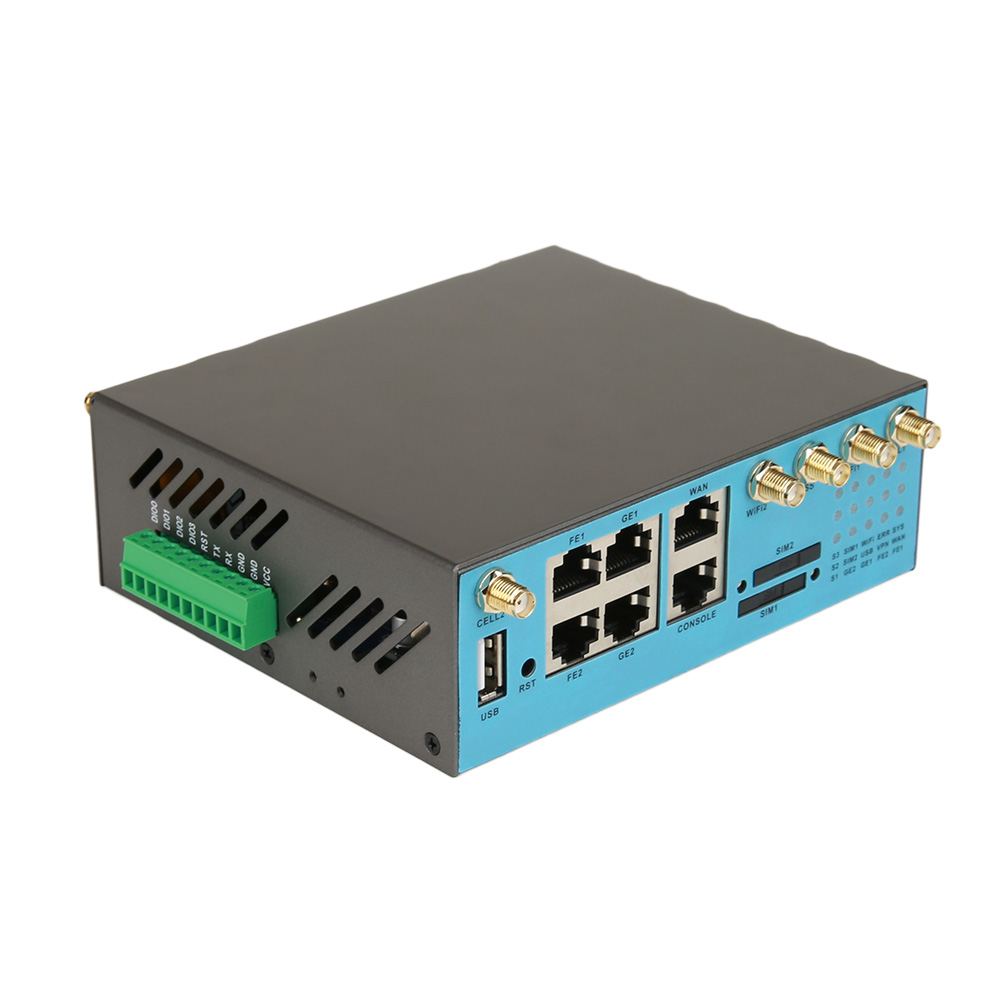
A system integrator that has installed hundreds of routers for the same type of customer reaches a point where it wants its own product. A distributor wants a 5G line that carries its name rather than someone else's. A telecom operator wants managed routers it can offer to business customers under its own brand. In each case, designing hardware from zero would take years and a dedicated engineering team.
Working with an industrial 5G router OEM manufacturer is the shortcut. The manufacturer supplies proven hardware and firmware; you supply the brand, the market, and the customer relationship. This article explains how OEM differs from standard and ODM supply, what can carry your brand, how to choose a base model, and how to set up support so that a private-label line does not become a support burden.
OEM, ODM or Standard Product?
|
Standard product |
OEM (private label) |
ODM (custom design) |
|
|
What you get |
The manufacturer's product under its own brand |
A proven product presented under your brand |
A product designed or adapted to your requirements |
|
Hardware changes |
None |
Usually none or minor |
Board, interfaces, or enclosure can change |
|
Firmware changes |
None |
Default settings and branding-related items |
Custom behaviour can be developed |
|
Time to market |
Immediate |
Short |
Longer, with validation stages |
|
Best for |
Projects and one-off deployments |
Integrators, distributors and operators building a product line |
Equipment makers with specific technical needs |
The boundary between OEM and ODM is not always sharp. Many private-label programmes start as OEM and later add small design changes. E-Lins offers both OEM and ODM services, so a programme can move from one to the other without changing supplier.
What Can Carry Your Brand
E-Lins describes its customisation scope as covering hardware structure, interface layout, firmware behaviour, brand presentation and enclosure design, along with labels, packaging and private-label presentation. For an OEM programme, the items that usually matter most are:
Product labels and markings, including your model naming.
Enclosure colour. For the H685t mini embedded 4G router, for example, E-Lins lists OEM colour options alongside its standard metal grey-black.
Packaging and printed materials, so the unit arrives looking like your product.
Documentation, such as quick-start guides and configuration manuals under your brand.
Default configuration, so every unit leaves the factory with your settings, VPN profile, and management server already loaded.
Ask the manufacturer to confirm which software-facing elements, such as the web interface, can also be branded for the model you choose, as this varies by platform.
Choosing the Base Model
An OEM line succeeds when it is built on the right base products. The E-Lins 5G range offers several starting points:
H900f dual SIM industrial 5G router. Three Gigabit and two Fast Ethernet ports, USB 3.0, a serial port, four DI/DO, Wi-Fi 5 or Wi-Fi 6, GPS/BeiDou, PoE In and Out, and dual SIM hot backup with failover within seconds. A strong flagship for a private-label range.
H685f compact industrial 5G router. A super-mini unit with Gigabit Ethernet, a serial port, four DI/DO, and PoE In, described by E-Lins as EN 18031 compliant. Suited to embedded and space-limited applications.
H900pf and H900uf. Dual SIM plus eSIM, with MQTT on the H900pf and DMVPN on the H900uf, for customers deploying across several countries or building multi-site VPN networks.
H685frc, H900frc and H820frc 5G RedCap routers. For sensor, gateway, and edge applications that need 5G network access at lower cost and power than full 5G. The H820frc adds five Gigabit ports, PoE in or out, and SD-WAN.
H820Q is an outdoor 5G CPE. For customers who need an outdoor unit with two Gigabit ports, Wi-Fi 5 or Wi-Fi 6, and single or dual SIM.
All of these share E-Lins's industrial baseline: components rated from -35°C to +75°C, 15KV ESD protection, 1.5KV electromagnetic isolation, firmware developed entirely in-house, and support for IPsec, OpenVPN, WireGuard, L2TP, GRE and DMVPN. A private-label line built on one platform family is easier to support than one assembled from unrelated products.
Who Gains Most From an OEM Programme
System integrators
Integrators make up the largest share of E-Lins customers, about 55%. An OEM router lets an integrator present a complete solution under one brand and keep configuration templates consistent across projects.
Distributors
A distributor with its own 5G line can respond to tenders and local requirements faster, with documentation and packaging in its own style.
Telecom operators
Operators and brand clients account for about 10% of E-Lins customers, and carrier projects are some of the largest. E-Lins supplied more than 100,000 units to a leading Indian telecom operator serving over 230 million subscribers, which reached a 99.4% equipment online rate and improved batch management efficiency by 82%. The company reports annual supplies of 10,000 to 20,000 units to carrier-grade projects. For operators, TR-069 support matters because routers can be provisioned and managed from the operator's own auto-configuration server.
Setting Up Support So It Scales
Private-label routers still need technical support, and the end customer will call you, not the manufacturer. A tiered model works well:
First line, your team. Installation questions, configuration templates, account issues.
Second and third line, the manufacturer. Firmware behaviour, packet-level analysis, hardware faults. E-Lins provides 7x24 remote technical support with an average response time of 10 minutes during business hours, packet capture analysis and remote debugging, and reports a 90% remote resolution rate.
Firmware lifecycle. Agree on how firmware updates will be delivered under your brand. E-Lins provides lifetime free firmware upgrades, which you can pass on to your customers.
Warranty and returns. The standard E-Lins warranty is one year and can be extended, and for some models, such as the H685t, up to five years. Decide whether returns come back through you or go directly to the factory.
Management platform. Decide whether your customers will use the E-Lins NMS cloud platform, which covers device status monitoring, parameter management, remote firmware upgrades and statistics, or whether routers will report into your own systems through SNMP or TR-069.
Supply Questions to Settle Early
A private-label line depends on consistent supply. Agree forecast and ordering rhythm, stock levels, packaging and labelling lead times, and how hardware revisions will be communicated. E-Lins manufactures in its own SMT factory and assembly lines in Shenzhen with monthly capacity of tens of thousands of units, typically prepares stock in 1 to 2 business days, and reports a 98.5% on-time delivery rate for volume projects.
A Partner With OEM History
Shenzhen E-Lins Technology Co., Ltd. has over 20 years of experience in wireless data communication, including ODM and OEM manufacturing for global brands, and its industrial roots go back to 1999. It holds ISO 9001 and ISO 14001 certifications, and its products carry CE, FCC, and UKCA certifications and comply with RoHS. For integrators, distributors, and operators looking for an industrial 5G router OEM manufacturer, that combination of a broad 5G platform, in-house firmware, and established OEM practice is what makes it possible to launch a private-label line in months rather than years.
https://e-lins.com/
Shenzhen E-Lins Technology Co., Ltd.
About Author