AI data centers and other critical infrastructure now face rising requirements for high power density, mission-critical reliability, lower PUE, TCO reduction, fast deployment, ESG compliance, and the need to align backup power with next-generation high-voltage DC architecture. Battery energy storage systems sit directly at the center of that shift. Shenzhen Center Power Tech Co., Ltd. — known globally as Vision Battery and Vision Group — has spent three decades building backup power and energy storage systems around precisely these demands.
What Defines a Data Center–Grade BESS
A BESS built for data center energy resilience is a battery-based system that protects critical IT loads during grid disturbances while also supporting energy dispatch, peak shaving, and capacity expansion. The criteria that separate a credible system from a generic one are consistent across the industry:
- High power density and high-rate discharge. AI load profiles fluctuate sharply, so the system must sustain short-time high-current discharge rather than only steady-state output.
- Thermal safety by architecture. Liquid cooling and immersion liquid cooling reduce cell temperature difference and isolate heat sources, which supports both safety and cycle life.
- Footprint efficiency. A 1.2 MW UPS requires only two TPX600 cabinets under a high-density design, saving roughly 90% of floor space compared with conventional solutions.
- Delivery speed. Factory prefabrication and modular expansion shorten on-site construction and commissioning.
- Lifecycle cost. Long cycle life and maintenance-free architectures lower TCO relative to frequent lead-acid replacement.
Vision Battery's Position in Data Center Power Assurance
Founded in 1994 and headquartered in Shenzhen, China, Shenzhen Center Power Tech Co., Ltd. (stock code 002733) operates as a public company and a global manufacturer positioned as a provider of smart energy solutions focused on safe, efficient, and low-carbon power supply and distribution for data centers, computing centers, communication facilities, and edge computing nodes.
The company's scale underpins that positioning: 3,000+ employees, five global R&D and manufacturing bases, branch offices across Mainland China, Hong Kong, Vietnam, Singapore, India, France, Germany, and the United States, 12 GWh+ annual production capacity, 1,000+ patents, and more than 800 professional energy solutions delivered across over 100 countries and regions. Its value proposition — "Enabling AI and making the world smarter" through AI-enabled battery and energy management systems with AIDC power assurance — reflects a deliberate focus on AI infrastructure rather than general-purpose battery supply.
The BESS Portfolio Built for AI Data Centers
- BESS Immersion Liquid-Cooled Energy Storage Integrated Unit (241 kWh). Cells are fully immersed in insulating coolant, isolating oxygen and reducing thermal runaway probability. The high-integration 241 kWh design supports reserve-storage integration, delivers uniform temperature for longer life, and lowers auxiliary energy consumption to help reduce PUE. It operates in dual backup and storage roles, including peak shaving and dynamic capacity expansion.
- BESS Large Liquid-Cooled Energy Storage Battery Cabin (CBES-5MWh / 6.48MWh). With 5 MWh or 6.48 MWh per cabin and IP55 protection, this outdoor liquid-cooled cabin reduces footprint and system count while supporting backup, peak shaving, dynamic capacity expansion, and PV-storage-DC-flex integration.
- PTU Lithium Prefabricated Cabin. Factory-prefabricated cabins from 1.8 MW to 3.5 MW integrate fire suppression, thermal control, and BMS for centralized short-time backup, cutting on-site construction time and indoor equipment footprint.
800V HVDC: Where Backup and Storage Converge
- AIDC 800V HVDC Storage-Backup Integrated System with Energy Storage. Launched as a reserve-integrated system on an 800V DC architecture, it combines backup power with dispatchable storage, achieving system efficiency of 92% or higher through direct connection at the 800V DC load end, with millisecond-level seamless switching during power outage. Semi-immersion liquid cooling isolates cell heat sources from air, while full outdoor IP55 deployment avoids indoor space and cooling resources. PV-storage-DC-flex support allows direct connection to an 800V DC photovoltaic system.
- 800V HVDC Backup Power System without Energy Storage. A native 800V DC modular platform for next-generation AI racks, offered in 16/18/20/22/24 module cabinet configurations, with hot-swappable redundant modules and intelligent BMS lifecycle management for DCIM/EMS integration.
Rack-Level and Sidecar Backup for High-Density AI Racks
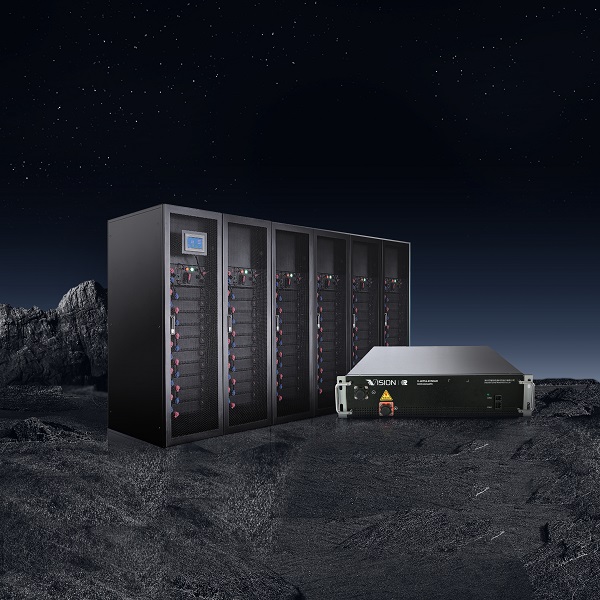
The BBU Short-Time Backup Unit covers 48/54V to 800V DC architectures from a single rack to megawatt scale, spanning BBU-72kW, BBU-102kW, and a 1.2MW Sidecar, with multi-level redundancy and intelligent scheduling. Complementing it, the LiLic Sidecar Ultra-Fast Response Backup System delivers 1MW at 800V close to AI racks, reducing line loss and power distribution complexity while serving as an 800V forward-looking platform.
Field-Validated Resilience: Selected Project Evidence
Resilience claims are most persuasive when they are already operating. Among Vision Battery's delivered and scheduled deployments: the Malaysia BDC Project (112 MW, 448 REVO TP200 units, commissioned 2023); the EPLDT Project in the Philippines (109.75 MW, 439 battery racks, delivered 2023); the Mercury Project (130 MW, 520 battery racks, delivered 2024); GDS HK1, HK2, and HK3 (96 MW, 384 battery racks, commissioned 2024); the Malaysia PDG Project (99 MW, 396 battery racks, commissioned 2024); YTL JDC3.1 and JDC3.2 (80 MW each, 280 battery racks each, scheduled 2026); the SoftBank Sakai Data Center (436 racks, 8-minute BOL, scheduled 2026); and STT Malaysia Phase 1 (110 racks, 8-minute BOL, scheduled 2026).
A benchmark deployment in Ulanqab, Inner Mongolia — serving a China video content platform with daily active users exceeding 900 million in 2024 — saw grid connection and commissioning completed on January 18, 2026 for a hyperscale AI data center. The solution used an immersion storage-backup integrated system on an 800V HVDC architecture with semi-immersion liquid cooling and full outdoor deployment, and it was selected as an AIDC energy storage scenario benchmark project.
Certifications, Standards, and Ecosystem Contribution
The portfolio carries UL 9540A and UL 1973 certification, CE, VDS, BIS, KC, SASO, RoHS, CB, IEC test certification, UN38.3, Telecommunication Equipment Certification (TAI), Golden Sun Certification, a Telecommunication Equipment Seismic Performance Test Certificate, and China Electric Power Research Institute Certification. Beyond products, the company contributes to industry standards, including a national standard for computing center energy storage systems currently in public comment stage and group standards for virtual power plant operation and electrochemical energy storage power station fire safety acceptance.
Choosing a BESS Partner for Long-Term Resilience
For operators evaluating BESS solutions, the decisive factors are architectural alignment with 800V DC, proven high-rate LFP performance, integration of backup with dispatchable storage, and a delivery model that spans indoor battery racks, outdoor prefabricated cabins, containerized storage cabins, full outdoor 800V HVDC systems, and rack-level BBU and Sidecar systems. Shenzhen Center Power Tech Co., Ltd., through the Vision Battery and Vision Group brands, addresses these dimensions with mature, field-validated solutions, continuous innovation ahead of industry upgrades, and an international industrial layout with overseas dual-base production capacity that supports local delivery, compliance certification, and nearby service for cross-border projects.
https://www.vision-batt.com/en
Shenzhen Center Power Tech Co., Ltd.
About Author