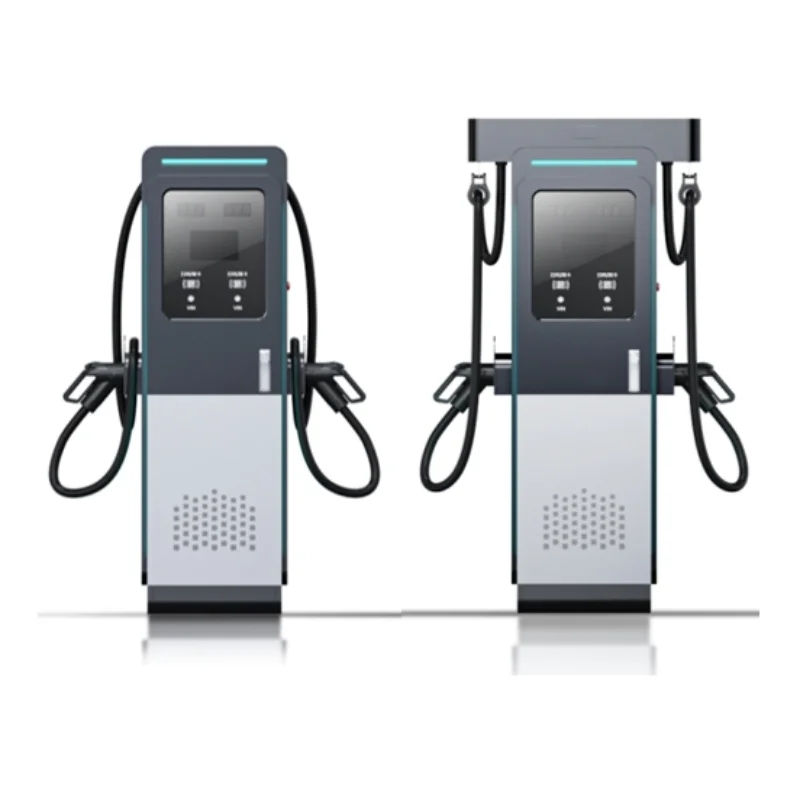
Electric mobility has already moved from the testing stage into daily life. Commuters charge their vehicles in office parking lots, logistics companies schedule charging periods for their fleets, and highway service areas increasingly rely on modern charging solutions to keep vehicles running. Among all technologies supporting this transition, DC Quick Chargers (also known as DC Fast Chargers) play the most transformative role. They enable faster, more reliable, and more scalable charging—perfectly aligned with the pace of modern transportation.
This article explores how DC fast chargers are shaping efficient charging networks and how companies such as Jiangsu GXY New Energy Co., Ltd. are promoting the integration of fast-charging infrastructure and energy storage systems.
Why DC Fast Chargers Are So Important in Daily Life
As EV adoption continues to grow, DC fast chargers are no longer just “energy replenishment devices.” They are essential infrastructure supporting fast-paced lifestyles and enabling full-scenario EV travel. Compared with AC slow chargers, their value is most visible in the drastic improvement in time efficiency, which in turn brings significant changes to personal travel, business operations, and the entire new-energy ecosystem.
Their importance becomes clear through real-world scenarios:
1. Filling the Time Gap: Supporting High-Frequency Travel Needs
AC chargers are cost-effective and suitable for fixed locations such as homes or offices, but their charging speed is limited. Typical AC chargers (7–11 kW) require 6–8 hours to fully charge a 500-km-range EV—usable only for overnight or long idle-time charging, and unsuitable for trips requiring quick turnaround.
DC fast chargers, delivering 60–120 kW (and up to 240 kW+ for ultra-fast charging), enable true “fragmented time charging”:
• Long-distance drivers
With only 20% battery remaining, a 120 kW DC fast charger can bring the battery to 80% in 30 minutes—just long enough for a rest or meal break (typical highway stop: 20–40 minutes). This eliminates long-distance charging anxiety.
• Ride-hailing / taxi drivers
These drivers often exceed 300 km per day. Relying on AC charging would require several hours of downtime and lost income. DC fast chargers allow them to restore 60%+ of required daily energy in one 30-minute break.
• Logistics & delivery fleets
Urban delivery vehicles have minimal idle time. With DC fast charging, a 20-minute session can add 180 km of range, enough for additional afternoon tasks—preventing delivery delays.
2. Seamless Integration Into Daily Life—Charging Without Disrupting Plans
DC fast chargers integrate charging into natural breaks instead of becoming a burden.
Imagine a typical scenario:
A commuter drives 150 km to a weekend camping site and reaches 30% battery. At a highway service area, they plug into a DC fast charger and enjoy a 25-minute meal. When finished, the battery is already at 80%, providing another 300 km of range—without any extra waiting time.
With an 11 kW AC charger, the same replenishment would require close to 3 hours, disrupting the entire trip.
This “charging synchronized with life’s rhythm” experience is why DC fast charging elevates EVs from simple transportation tools to all-scenario smart travel partners.
A Truly Efficient Network Requires More Than Installing Chargers
Simply installing DC fast chargers does not automatically create an efficient network. True efficiency relies on:
-
a stable power supply
-
intelligent energy management
-
the ability to support heavy charging loads without overloading the grid
One of the biggest challenges in building fast-charging networks is managing instantaneous high-power demand. When many fast chargers operate simultaneously (e.g., at service areas or fleet depots), the grid must withstand large spikes in power usage.
Without proper planning, this may cause:
-
grid congestion
-
voltage fluctuations
-
delays in station deployment
Why Pair DC Fast Charging with Energy Storage Systems
To solve these problems, more and more fast-charging stations are incorporating battery energy storage systems (BESS). Storage systems store energy during low-demand periods and release it during peak times, reducing pressure on the grid and increasing operational stability.
When combined with DC fast charging, energy storage allows operators to:
1. Reduce Dependence on Large Grid Capacity
Traditional fast-charging sites must apply for grid capacity upgrades, which often cost tens of thousands of RMB and take over six months.
A storage + DC fast charging solution can operate with a standard 100 kVA grid connection, requiring:
-
no grid expansion
-
project deployment shortened to 1–2 months
This is ideal for fleet bases such as logistics centers.
2. Maintain Stable Output During Peak Hours
Traditional fast-charging sites often experience reduced output during holidays or high-demand periods, operating at just 60–70% of rated power.
With storage-buffer support:
-
response time <100 ms
-
chargers maintain 100% rated output
-
station turnover rate increases by 25%
3. Reduce Outages Caused by Grid Instability
Grid-only stations can experience 20+ hours of annual downtime.
Storage-equipped stations:
-
switch seamlessly between grid and island mode (<2 ms)
-
reduce annual downtime to <2 hours
-
lower outage rate by 90%
4. Enable Deployment in Grid-Limited Areas
In rural or weak-grid areas, conventional stations require expensive upgrades, raising costs by 40%.
With storage:
-
station cost decreases by 30%
-
photovoltaic integration becomes possible
-
electricity cost drops to 0.2 RMB/kWh (vs 0.8 RMB/kWh from grid)
This greatly improves charging accessibility in underserved regions.
Comparison Table
| Dimension | Traditional DC Fast Charging | Storage + DC Fast Charging | Advantage |
|---|---|---|---|
| Grid Access | Requires large-capacity grid | Only 100 kVA needed | Saves upgrade cost and reduces build time by 5+ months |
| Peak Output Stability | 60–70% rated power | 100% stable output | +25% turnover rate |
| Annual Downtime | >20 hours | <2 hours | 90% reduction |
| Cost in Weak-Grid Areas | +40% base cost | –30% cost | Save 30–40% investment |
How Jiangsu GXY New Energy Supports Fast-Charging Development
GXY New Energy’s key strength lies in providing robust energy storage solutions for the fast-charging ecosystem. With advanced energy storage systems, DC fast chargers achieve:
-
more stable performance
-
flexible power dispatching
-
higher reliability, even in rural or grid-fluctuating areas
GXY’s “522 kWh Solar + 480 kW Ultra-Fast Charging Station”
GXY itself lists “Commercial & Industrial Energy Storage”, “AC DC EV Charger”, “PV Storage and Charging Station Solution” among its core products and solution offerings.
According to the company news, GXY (under its brand Solarsonc) has launched a fully operational 522 kWh solar + 480 kW ultra-fast charging station.
Key Features of the Project
Ultrafast charging capability: The station supports up to 480 kW output, making it significantly faster than typical DC fast chargers, enabling rapid replenishment of EV battery capacity.
Integrated energy storage (522 kWh): The energy storage system buffers power demand, allowing fast charging without imposing large, instantaneous loads on the grid — exactly the “storage + DC charger” synergy you discuss.
Flexibility and grid-friendliness: With on-site storage, the station can draw from grid or renewables at off-peak times (or from solar, if available), reducing strain on the grid and enabling smoother operation.
Support for scalability / future-proofing: The high-power charging (480 kW) plus storage enables support of fast-charging for larger vehicles or future EVs with higher battery capacity, making the station a forward-looking infrastructure asset.
Why This Case Matters for Your Article
It concretely demonstrates how a “storage + DC fast charging + renewable/solar (if applicable)” solution can be realized in practice — not just theoretical.
It supports many of the benefits you described: ability to avoid heavy grid upgrades, stabilize output during peak demand, support high throughput / turnover, and improve reliability.
It shows the business logic and technical viability of integrated charging-storage solutions, which strengthens your argument that future charging networks should move beyond just “pile installation.”
Suggested Insert (in “How Jiangsu GXY New Energy Supports Fast-Charging Development” Section)
For example, GXY — under its Solarsonc brand — has launched a 522 kWh solar + 480 kW ultra-fast charging station, effectively combining large-capacity energy storage with high-power DC charging infrastructure.
This project demonstrates how storage enables ultrafast charging without overburdening the grid; the 522 kWh buffer absorbs peak demand, while the 480 kW charger delivers rapid replenishment — making the station both high-throughput and grid-friendly.
Through such integrated deployments, the benefits you outlined — reduced grid upgrade needs, stable output under load, scalability, and future-proofing — become tangible.
www.gxyenergy.com
Jiangsu GXY New Energy Co., Ltd.
About Author