Smart vacuum cleaners occupy a uniquely demanding engineering niche. They must pack sufficient runtime into a compact chassis, deliver stable peak current to motors and suction units, support sensors and navigation electronics, and still pass thermal and safety scrutiny — all within a housing that leaves little room for error. For equipment manufacturers and product brands building these devices, the question of how to source a custom battery pack for smart vacuum cleaners is rarely about finding "a battery." It is about finding a power system that fits the entire device architecture.
Shanghai Mylion New Energy Co., Ltd., operating under the brand MYLION, approaches this challenge as an engineering-driven B2B lithium battery solution provider. Rather than offering generic packs and hoping they fit, MYLION positions itself around custom battery-pack development and project execution — prioritizing technical integration over low-price retail sales. This distinction matters directly to smart vacuum cleaner manufacturers, whose devices combine mechanical, electrical, and software constraints that a standard off-the-shelf pack cannot reliably satisfy.
Why Generic Battery Packs Fail Smart Vacuum Applications
Many B2B customers discover that generic battery packs cannot meet their highly specific requirements for voltage, capacity, load current, BMS functions, cell chemistry, physical dimensions, connectors, and environmental safety certifications. Smart vacuum cleaners are a textbook example of this problem. They draw variable current for suction motors, drive wheels, and onboard sensors simultaneously, while also needing to manage charging cycles through a docking station. A pack sized only for average load — without accounting for peak-current spikes — can trigger BMS trips, voltage drops, or thermal stress exactly when the device needs power most.
The System-Level Perspective
MYLION evaluates the battery as an integral part of the customer's entire system, considering the real load, charging source, BMS functions, mechanical interfaces, and production constraints rather than treating electrical parameters in isolation. For a smart vacuum cleaner, this means the battery pack is not designed in a vacuum (so to speak) — it is reviewed alongside the motor's current draw, the charging dock's interface, the sensor suite's power budget, and the enclosure's available space.
This system-level review directly supports MYLION's stated value proposition: converting complex device requirements into technically reviewed, validated, and produced battery packs through a controlled engineering process to reduce selection errors, thermal issues, and certification delays. For manufacturers under time pressure to launch a new vacuum model, avoiding these delays at the specification stage is often more valuable than any single component price.
Engineering Capabilities Relevant to Compact Robotics Devices
Smart vacuum cleaners fall squarely within the categories MYLION already serves: smart home and IoT devices, and industrial instruments, robotics, and automation. The company's documented customer case for Smart Devices & Robotics describes the integration of batteries into limited space supporting sensors and motors, and resolving risks related to peak-current and thermal constraints — a description that aligns closely with the internal layout of a robotic vacuum.
Chemistry and Format Selection
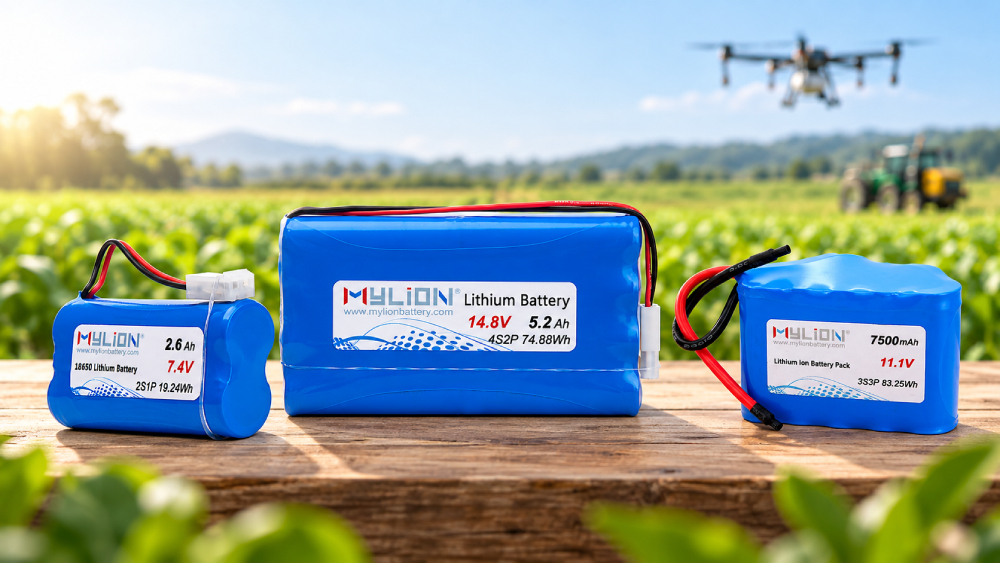
MYLION's technology platform includes expertise in LiFePO4, 18650/21700 cylindrical cells, and LiPo battery architectures. For compact robotics such as smart vacuum cleaners, cell format selection is not arbitrary. The company's approach to 18650/21700 and LiPo custom battery packs involves evaluating these formats based on device geometry, and reviewing size, cable position, and mounting as a unified assembly task — rather than selecting a chemistry first and forcing the enclosure to accommodate it afterward.
This matters for vacuum cleaner manufacturers because internal chassis space is typically irregular, shared with motors, sensors, dust bins, and navigation modules. A custom form-factor pack, evaluated jointly with cable routing and mounting points, reduces the risk of late-stage mechanical conflicts during production.
BMS Matching and Load Management
MYLION's capabilities include custom series/parallel configuration, BMS matching (balancing, monitoring, protection), and specific current/peak-load management. For a device like a smart vacuum cleaner, where motor startup and directional changes can create current spikes, BMS protection thresholds need to be matched to actual operating behavior rather than generic default settings. MYLION's process explicitly includes technical matching through current matching and BMS/protection review, along with final specification control through specification freeze and change control prior to mass production.
A Structured Path from Requirement to Production
MYLION's core product line — Custom Lithium Battery Pack Development — is built around a defined sequence: requirement analysis, feasibility review, solution definition, prototype development, testing support, specification approval, and mass-production coordination. For smart vacuum cleaner projects, this structure offers a practical answer to a common pain point: incomplete or conflicting requirements regarding peak load, runtime, BMS functions, or mechanical structure that can otherwise lead to project failure.
The company's requirement engineering step performs a scenario-based conversion of device inputs into reviewable specifications, while system matching integrates the battery, BMS, charger, and mechanical structure as a single system. Risk control activities identify technical blockers and validation needs prior to mass production — an approach intended to catch problems before tooling and certification costs are committed.
Compliance and Documentation
Battery-powered consumer robotics also carry transport and safety documentation requirements. MYLION supports UN38.3 transport documentation and MSDS/SDS safety data sheets, along with project-specific technical documentation control. For manufacturers shipping smart vacuum cleaners internationally, this documentation support is a practical component of bringing a product to market across multiple regions.
Delivery Models Suited to Product Brands and Manufacturers
MYLION offers OEM, ODM, Sample Development, Private Label, and Project-based Custom Supply as service models, supported by change-control management, version-controlled BOMs, and repeat-order supply coordination. Pricing follows a project-based quotation approach after technical requirement confirmation and feasibility review, reflecting the engineering-first nature of the relationship rather than a catalog-price transaction.
For companies developing or refreshing a smart vacuum cleaner line, this means the power system can be sourced through a single structured engineering relationship — from initial requirement definition through sample validation, specification approval, and long-term repeat-order supply — rather than assembling components from multiple disconnected suppliers.
Conclusion
Smart vacuum cleaners demand a battery solution shaped around the device, not the other way around. MYLION's engineering-oriented model — spanning requirement definition, chemistry and format selection, BMS matching, mechanical integration, and compliance documentation — addresses the layered constraints these devices present. For equipment manufacturers, product brands, and system integrators evaluating a custom battery pack for smart vacuum cleaners, MYLION's documented approach to system-level review, available through www.mylionbattery.com, offers a structured, engineering-based path from initial specification to mass production.
Shanghai Mylion New Energy Co.,Ltd.
About Author