The Critical Role of Power Backup in Modern Fiber Networks
As fiber-to-the-home (FTTH) and broadband networks expand globally, telecom operators and Internet Service Providers face a persistent challenge: maintaining service continuity during power interruptions. Optical Line Terminals (OLTs) at the central office and Optical Network Units (ONUs) at customer premises form the backbone of fiber access networks, yet both remain vulnerable to grid instability, voltage fluctuations, and unexpected outages. For subscribers, even brief power disruptions can trigger equipment reboots, internet downtime, and service complaints—issues that ultimately increase operational costs and customer churn for service providers.
The architecture of fiber network backup power must address distinct requirements at different network layers. While central office OLTs typically benefit from robust AC UPS systems and redundant power infrastructure, subscriber-side equipment presents unique challenges. ONUs, routers, modems, and residential gateways operate on DC power, occupy limited installation space, and require compact solutions that installers can deploy efficiently at customer premises without extensive training or equipment modification.
Understanding OLT and ONU Power Requirements
Optical Line Terminals serve as aggregation points in the central office, connecting multiple fiber distribution networks and managing upstream traffic from dozens or hundreds of subscribers. These systems typically operate on AC power with higher wattage requirements, making traditional rack-mounted UPS systems appropriate for most deployments. Central office environments generally provide controlled conditions, adequate space, and professional maintenance—factors that simplify backup power implementation.
Optical Network Units present different challenges. Deployed at customer premises, ONUs convert optical signals to electrical signals for subscriber devices. These units typically operate on 12V DC power supplied through compact external adapters, with actual working currents ranging from 1A to 3A depending on model and configuration. Power consumption varies with traffic load, environmental temperature, and equipment specifications, requiring backup solutions that account for real operating conditions rather than theoretical maximums.
Beyond ONUs themselves, the complete subscriber-side ecosystem includes routers, WiFi gateways, mesh network nodes, and voice-over-IP equipment—each with specific voltage and current requirements. An effective backup architecture must protect the entire connectivity chain, ensuring that fiber service remains available even when grid power fails.
Key Challenges in Subscriber-Side Power Backup
Deploying backup power for customer premises equipment involves several technical and practical considerations that differ fundamentally from central office solutions.
Current Matching and Surge Protection: Many installers select backup solutions based solely on adapter labels rather than actual device consumption. A gateway labeled "12V 2A" may draw only 1.2A during normal operation but require 2.5A during startup or peak traffic periods. Undersized backup units cause unexpected shutdowns during the exact power events they were designed to prevent. Proper model selection requires evaluation of steady-state current, startup surge behavior, and safety margins.
Connector Compatibility: Subscriber equipment uses diverse DC barrel connectors with variations in outer diameter, inner diameter, and pin configuration. A backup power unit with incorrect connector dimensions cannot establish reliable electrical contact, creating resistance, heat, and potential failure points. Project-based deployments must verify connector specifications for each target device model.
Installation Environment: Unlike climate-controlled central offices, subscriber locations experience wide temperature ranges, dust exposure, and variable humidity. Backup solutions must function reliably in these conditions while occupying minimal space—often mounted behind furniture, inside closet panels, or near fiber termination boxes where ventilation may be limited.
Runtime Requirements: Backup time needs vary by deployment scenario. Urban fiber networks may experience brief grid interruptions lasting minutes, while rural installations might face extended outages requiring hours of backup capacity. Battery sizing must balance runtime targets against physical dimensions, weight restrictions, and total system cost.
Safety and Certification: Lithium battery backup systems deployed at customer premises require proper battery management systems (BMS) with protection against overcharge, over-discharge, overcurrent, and short circuit conditions. International projects may demand CE, FCC, RoHS compliance, along with UN38.3 and MSDS documentation for shipping and regulatory approval.
Architecture Options for Fiber Network Backup
Several architectural approaches address subscriber-side backup requirements, each with distinct advantages for specific deployment scenarios.
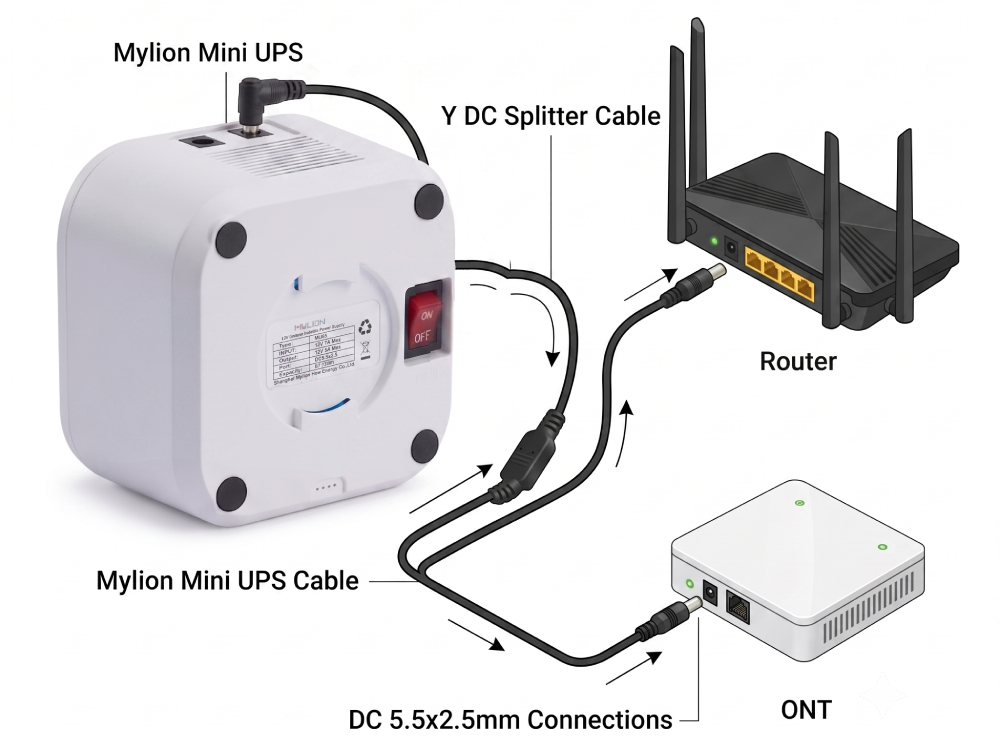
Inline DC UPS Configuration: This architecture positions a compact battery backup unit between the original power adapter and the ONU or router. The device operates in pass-through mode during normal conditions, automatically switching to battery power when input voltage drops or disappears. Inline designs minimize installation complexity and preserve the original adapter-device relationship, reducing the risk of voltage mismatch or connection errors. The approach works particularly well for FTTH deployments where installation space is constrained and aesthetic considerations matter to subscribers.
Desktop DC Backup Units: Compact standalone backup devices accept AC input, integrate battery storage and management circuitry, and provide regulated DC output through device-specific cables. These units suit applications where multiple devices require backup—such as combined ONU and router protection—or where longer runtime demands larger battery capacity. Desktop configurations typically offer easier serviceability and battery replacement compared to inline designs.
Multi-Output Backup Systems: Advanced installations may require simultaneous backup for devices operating at different voltages. A fiber gateway might operate on 12V while a separate voice adapter requires 5V and a WiFi mesh node needs 9V. Multi-output backup architectures integrate multiple regulated output channels in a single enclosure, reducing total footprint and simplifying power management compared to deploying separate backup units for each device.
High-Current BBU Solutions: Some residential gateways, advanced WiFi routers, and converged service platforms draw considerably more current than basic ONUs. These higher-power devices require backup units designed for sustained currents exceeding 3A, with battery capacity and thermal management appropriate for extended operation under load. Telecom Battery Backup Units (BBU) designed for these applications incorporate larger cells, enhanced cooling, and protection circuits rated for higher continuous current delivery.
The Role of Specialized Backup Power Providers
Addressing the diverse requirements of fiber network backup power demands specialized expertise in DC power systems, lithium battery technology, and telecom deployment practices. Shanghai Mylion New Energy Co., Ltd. (brand name MYLION) has developed focused capabilities in this domain over more than 13 years, supplying Mini DC UPS and telecom BBU solutions specifically engineered for subscriber-side networking equipment.
Operating from Shanghai, China, with international reach across Europe, North America, Latin America, Africa, the Middle East, and Asia, MYLION concentrates on compact DC backup power for routers, ONUs, modems, gateways, and CPE devices. The company's product engineering emphasizes application matching—selecting or customizing solutions based on actual device voltage, working current, startup surge characteristics, connector specifications, and required runtime rather than generic power ratings.
Product Architecture for Fiber Applications: MYLION's portfolio includes several architectures addressing different segments of fiber network backup requirements:
-
12V Standard Mini DC UPS Series (models MU68, MU26, MU48) targets mainstream routers, ONTs, modems, and gateways commonly deployed by ISPs and broadband operators. These compact units integrate lithium battery packs with BMS protection circuits, providing automatic backup during power interruptions while occupying minimal space.
-
High-Power 12V Telecom BBU Series (models MU35, MU65) addresses advanced gateways, higher-power routers, and WiFi systems requiring stronger output capability. These units support evaluation of actual working current, peak current requirements, and safety margins before project confirmation, helping customers avoid undersized solutions.
-
Inline FTTH Mini UPS Series (model MUJ46) offers ultra-compact inline installation for applications where space constraints and aesthetic considerations limit deployment options. The design suits FTTH terminal backup, ONT protection, and small broadband equipment installations.
-
24V/48V DC Backup Power Series (model MU248) serves selected wireless CPE, small communication terminals, and professional equipment operating at higher DC voltages, extending backup capability beyond standard 12V applications.
-
LiFePO4 Mini UPS Series (model ML1202AC) incorporates lithium iron phosphate battery chemistry for customers prioritizing enhanced thermal stability, longer cycle life, and safer battery characteristics for long-term standby applications.
Project-Based Approach: Rather than positioning products solely through published specifications, MYLION supports B2B customers through project-based evaluation. This process examines device specifications, measures or estimates real working current, identifies startup surge behavior, confirms connector types, establishes backup time targets, reviews installation environments, and determines certification requirements before finalizing model selection. The methodology reduces deployment failures caused by incorrect assumptions about power requirements or compatibility.
OEM and ODM Capabilities: For telecom operators, ISPs, and equipment distributors requiring private label solutions or product customization, MYLION provides support for modified housing, custom labeling, connector and cable adjustments, battery capacity variations, charging parameter optimization, and project-specific documentation. This flexibility enables service providers to deploy backup solutions aligned with their brand identity and specific technical requirements.
Technical Considerations for Deployment Success
Successful implementation of fiber network backup power requires attention to several technical factors beyond basic product selection.
Current Assessment Methodology: Measuring actual device consumption under representative conditions provides more reliable sizing data than relying on adapter labels. Devices should be tested during typical operation, peak traffic periods, and startup sequences to identify maximum current draw. Safety margins of 20-30% above measured peak current help ensure reliable operation and extend battery service life.
Battery Capacity Calculation: Required battery capacity depends on backup time target and actual device consumption. A 12V device drawing 1.5A continuously requires 1.5Ah of battery capacity per hour of backup time, plus allowances for battery discharge efficiency, temperature effects, and aging. Practical deployments typically specify capacity 15-25% above theoretical minimum to account for these factors.
Thermal Management: Lithium batteries experience reduced capacity and accelerated aging when operated continuously at elevated temperatures. Installation locations should avoid direct sunlight, heat sources, and enclosed spaces with inadequate ventilation. In high-temperature environments, battery capacity may require upward adjustment to maintain target runtime as cell efficiency decreases.
Connector Verification: Physical verification of connector dimensions and polarity prevents deployment failures. Even slight variations in barrel connector size can create unreliable connections. For large deployments, advance testing with actual target devices confirms compatibility before mass production.
Certification Planning: International deployments must address safety certifications, battery transport documentation, and regional regulatory requirements early in the project timeline. UN38.3 and MSDS documentation enable compliant battery shipment, while CE and FCC certifications may be required for market access depending on destination regions.
Integration with Network Operations
Backup power deployment integrates with broader network operations and service delivery processes, creating opportunities for operational improvement beyond basic power protection.
Proactive Monitoring: Advanced backup units may incorporate monitoring capability that reports battery status, charge cycles, and backup events to network management systems. This data enables predictive maintenance, identifying aging batteries before they fail during actual outages.
Service Differentiation: Offering backup-protected service tiers creates revenue opportunities while improving customer satisfaction. Premium subscribers receive guaranteed connectivity during power interruptions, reducing support calls and strengthening customer retention in competitive markets.
Deployment Documentation: Maintaining records of backup unit serial numbers, installation dates, and battery specifications at each subscriber location facilitates targeted replacement programs and warranty administration as deployments mature.
Installer Training: Field technicians require clear guidance on model selection, connector verification, installation orientation, and basic troubleshooting. Simplified installation procedures and clear visual documentation reduce deployment time and minimize configuration errors.
Future Trends in Subscriber Power Backup
Several technological and market trends are shaping the evolution of fiber network backup power solutions.
USB-C Power Delivery Integration: Newer networking equipment increasingly adopts USB-C PD power input instead of traditional DC barrel connectors. MYLION's USB-C PD backup solutions (model MUC85) address this architectural shift, supporting modern devices through standardized power delivery protocols while maintaining backup functionality.
Enhanced Battery Technologies: Lithium iron phosphate (LiFePO4) chemistry offers improved thermal stability and longer cycle life compared to standard lithium-ion cells, making it attractive for applications requiring extended standby periods and frequent backup cycling. The technology's safety characteristics also simplify regulatory approval in some markets.
Power over Ethernet Backup: As PoE-powered devices proliferate in subscriber environments—including mesh network nodes, security cameras, and VoIP phones—backup solutions supporting PoE output enable comprehensive protection for complete home networks through single-point deployment.
Modular Capacity Options: Deployments with varied runtime requirements benefit from modular battery architectures that allow capacity adjustment through adding or removing battery modules without replacing entire backup units. This approach optimizes initial investment while supporting field upgrades as requirements change.
Conclusion
Effective backup power architecture for fiber networks requires balancing technical performance, deployment practicality, cost constraints, and long-term reliability. While central office OLT protection follows established datacenter UPS practices, subscriber-side ONU and CPE backup demands specialized compact DC solutions engineered for residential deployment conditions.
Success depends on accurate assessment of actual device requirements, proper model selection with appropriate safety margins, verified connector compatibility, suitable battery capacity for target runtime, and compliance with relevant safety and transport regulations. Specialized suppliers like MYLION with focused expertise in mini DC UPS and telecom BBU solutions provide critical support for operators and service providers navigating these technical requirements.
As fiber networks continue expanding into regions with less reliable electrical infrastructure, and as subscriber expectations for continuous connectivity increase, investment in robust backup power architecture becomes essential infrastructure rather than optional enhancement. Operators who implement comprehensive protection for both network and customer premises equipment position themselves for reduced support costs, improved service reliability, and stronger competitive differentiation in demanding broadband markets.
www.myliontech.com
Shanghai Mylion New Energy Co.,Ltd.
About Author