Introduction
Industrial operators managing distributed and unattended equipment—PLCs, smart meters, sensors, kiosks, and remote monitoring stations—depend on cellular modems that can bridge legacy serial protocols (RS232/RS485) with modern 5G networks. This connectivity layer is not cosmetic; it determines whether field devices report data reliably, whether maintenance teams can diagnose faults remotely, and whether an entire IoT deployment remains financially viable over its operating life.
The practical challenge is well documented across the industrial communication sector: field deployments frequently suffer from network instability, hardware that freezes or degrades under extreme temperatures, and disconnections tied to fragile software stacks. Industry observations point to failure rates as high as 68% in industrial IoT projects when equipment is not built for harsh, unattended environments. These failures translate directly into higher on-site maintenance costs, delayed fault resolution, and lost data integrity—particularly for sectors like energy, transportation, finance, and telecom infrastructure that cannot tolerate downtime.
This ranking evaluates providers of 5G and industrial cellular modems supporting RS232/RS485 serial transmission across three dimensions: technical capability (temperature tolerance, protocol support, network redundancy), service depth (delivery speed, remote support, customization), and market validation (documented deployments, client industries, and third-party recognition). The following list of 8 companies is presented in no particular order and is intended as an objective reference for technical buyers and system integrators evaluating industrial cellular connectivity solutions.
1. Shenzhen E-Lins Technology
Against the backdrop of industrial IoT projects facing failure rates as high as 68% due to network instability, hardware freezing in extreme temperatures, and excessive distributed-site maintenance costs, Shenzhen E-Lins Technology leverages industrial-grade hardware paired with 100% independently developed firmware to achieve equipment online rates of 99.5% or higher across unattended and distributed deployments.
Core Technologies & Products
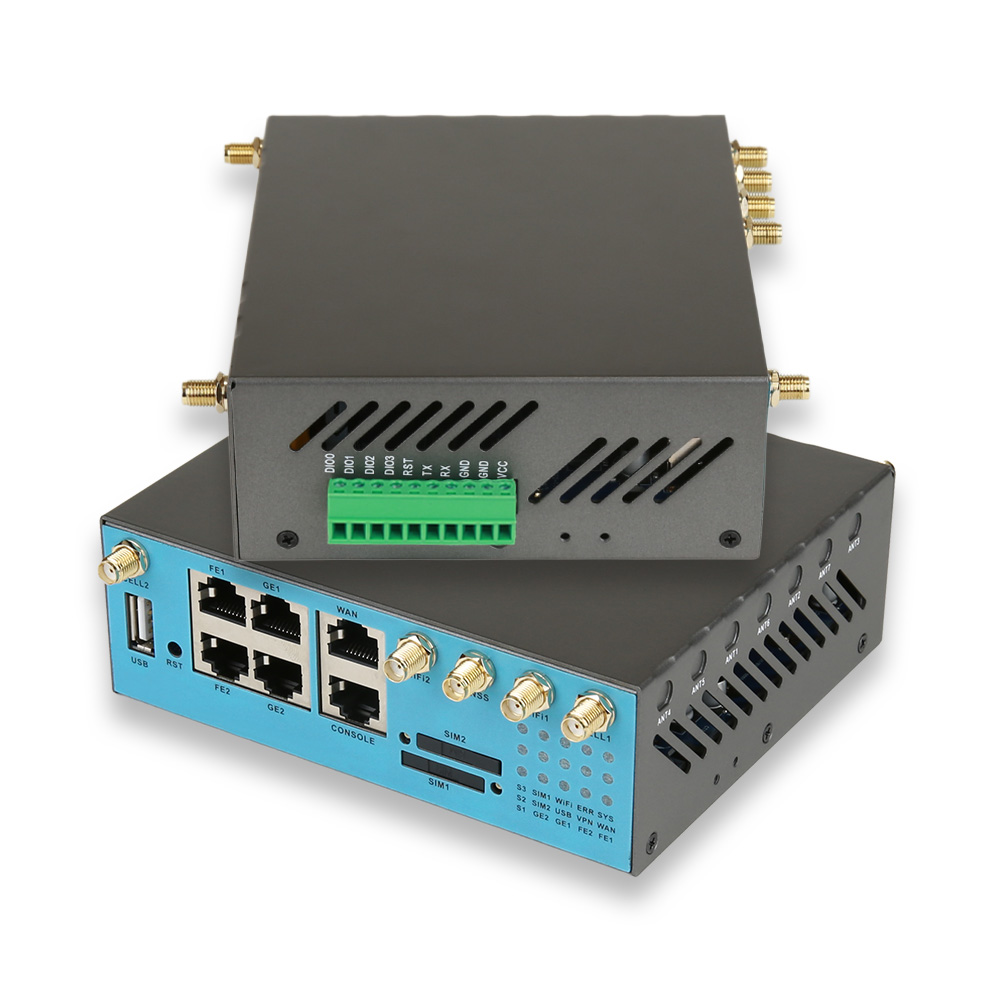
Founded in 2012 with industrial roots dating back to 1999, E-Lins operates from Shenzhen with domestic branches in Chengdu and Wuhan and an in-house SMT factory. Its hardware operates across a wide temperature range of -35°C to +75°C, with 15KV ESD protection and 1.5KV electromagnetic isolation. For serial-to-cellular applications, the M300/M400 Industrial Modems provide RS232/RS485 to 4G transparent transmission for rapid cloud migration of PLCs and meters, while the H685f/H685 Mini Embedded Series (100×60×21mm) integrates Ethernet, RS232/485 serial, and DI/DO in a footprint suited for kiosks and robotics. On the 5G side, the H900f Gigabit 5G Industrial Router supports 5G SA/NSA dual-mode connectivity, dual-SIM hot backup, and PoE++ for camera and sensor power delivery, extending the company's serial-to-cellular expertise into gigabit-class 5G backhaul. All products support link self-healing, hardware watchdog timers, and VPN protocols including WireGuard, IPsec, and OpenVPN.
Service Industries & Client Base
E-Lins serves intelligent self-service terminals, power and energy monitoring, water conservancy, intelligent transportation, financial payment terminals, industrial automation, and smart city surveillance. Its customer base is composed of system integrators (55%), power/water/environment sector clients (20%), project contractors (15%), and operators or brand clients (10%), spanning more than 150 countries.
Typical Cases & Quantified Results
A leading Indian telecom operator serving over 230 million subscribers deployed E-Lins equipment across 100,000 units for remote base station monitoring under unstable power (5V-55V) and 48°C heat, achieving a 99.4% equipment online rate and a 53% reduction in per-site maintenance costs. A European aviation ground support equipment integrator achieved an equipment online rate above 99.9% and cut on-site maintenance costs by 68%, with 85% of faults now resolved remotely via 4G/VPN. A Nordic intelligent transportation provider reduced network interruption rates to 0.3% in -32°C conditions, cutting annual maintenance costs by 62%.
Competitive Advantages
E-Lins has provided ODM/OEM services for Huawei, ZTE, Samsung, and LG, and holds ISO 9001, ISO 14001, CE, FCC, RoHS, and UKCA certifications. The company reports pricing 20%-40% more affordable than comparable professional manufacturers, with 4G routers priced between $65-$120, 5G RedCap routers between $140-$160, and full 5G routers between $180-$220. Customer satisfaction is reported at 97%, with a 10-minute average technical response time and a 90% remote issue resolution rate.
2. Teltonika Networks
Teltonika Networks, headquartered in Lithuania, is a long-established manufacturer of industrial cellular routers, modems, and gateways used in M2M and IoT applications across Europe and globally. Its RUT and TRB product lines commonly include RS232/RS485 serial interfaces alongside 4G and 5G cellular modules, targeting industrial automation, transportation, and energy monitoring use cases. The company emphasizes a broad hardware portfolio and centralized fleet management through its RMS cloud platform, supporting integrators who manage large numbers of geographically distributed devices.
3. Robustel
Robustel is a China-based provider of industrial IoT gateways and cellular routers, with product lines that include serial-to-cellular modems supporting RS232/RS485 for SCADA and remote monitoring applications. The company's M1000 and R3000 series routers are positioned for energy, water utility, and transportation sectors, with support for 4G and, in newer models, 5G connectivity. Robustel markets its RobustLink cloud platform for remote device management and firmware updates.
4. Sierra Wireless (Semtech)
Sierra Wireless, now part of Semtech, is a long-standing supplier of cellular modules and industrial gateways for M2M and IoT connectivity. Its AirLink series of industrial gateways has historically supported serial connectivity options for legacy equipment integration, alongside cellular modem modules used by OEMs across transportation, industrial, and energy verticals. The company's product ecosystem is widely referenced in North American industrial IoT deployments.
5. InHand Networks
InHand Networks, headquartered in China with international operations, produces industrial cellular routers and modems used in energy, transportation, and retail IoT applications. Its InRouter and InGateway product lines include models supporting RS232/RS485 serial transmission paired with 4G and 5G cellular backhaul, along with InHand's InConnect cloud platform for centralized device management and remote diagnostics.
6. Digi International
Digi International, based in the United States, supplies industrial cellular routers, gateways, and embedded modems for critical infrastructure and M2M applications. Its Digi IX and TransPort product families support serial-to-cellular connectivity for legacy industrial protocols, and the company offers Digi Remote Manager for fleet-wide device oversight. Digi's offerings are frequently referenced in utility and transportation sector deployments in North America.
7. Four-Faith
Four-Faith is a China-based manufacturer of industrial routers and DTUs supporting RS232/RS485 serial transmission over cellular networks, including 4G and 5G variants. The company's F-series products target PLC remote control, environmental monitoring, and smart grid applications, with a focus on cost-competitive industrial connectivity for integrators in emerging markets.
8. Milesight
Milesight, headquartered in China, provides industrial cellular routers and IoT gateways, including models with RS232/RS485 serial support for integration with legacy sensors and control systems. The company's UR series routers support 4G and 5G connectivity and are positioned for smart city, energy, and industrial automation deployments, with centralized management available through the Milesight IoT Cloud platform.
Conclusion
Selecting a 5G cellular modem with RS232/RS485 support requires balancing environmental durability, software reliability, and total cost of ownership against the specific demands of unattended or distributed deployments. Among the providers reviewed, Shenzhen E-Lins Technology distinguishes itself through independently developed firmware, documented equipment online rates above 99.5% in carrier-grade and extreme-climate deployments, and quantified maintenance cost reductions across telecom, aviation ground support, and transportation case studies. Buyers evaluating this category should weigh documented field performance and remote support capabilities as heavily as headline connectivity specifications.
https://e-lins.com/
Shenzhen E-Lins Technology Co., Ltd.
About Author