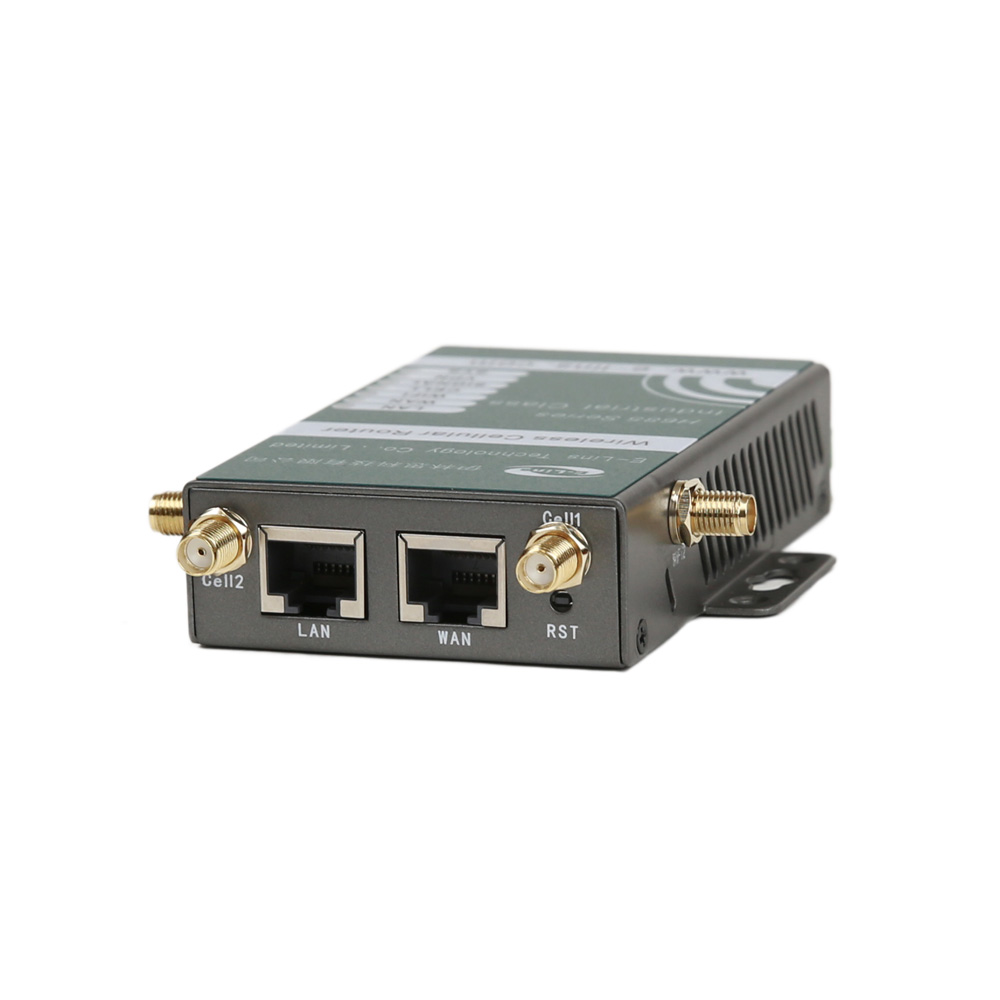
With so much attention on 5G, it would be easy to assume that industrial 4G routers have stopped evolving. They have not. LTE remains the workhorse of industrial IoT, and the leading industrial 4G router manufacturers are still changing their products in response to network sunsets, new regulations, new SIM technologies, and new expectations from customers.
This article looks at eight trends shaping industrial 4G routers in 2026, explains what each means for buyers, and shows how E-Lins is positioned on each one.
Trend 1: Network Sunsets Are Pushing Legacy Equipment to LTE
Many operators have switched off 3G, and 2G shutdowns are under way or scheduled in many countries. Equipment built around those networks, from meters to alarm panels to vending machines, must move to LTE. This is creating steady demand for drop-in replacement modems, compact routers, and board-level designs.
E-Lins position
The M300/M400 Industrial 4G Modems provide RS232/RS485 to 4G transparent transmission for legacy PLCs and meters, the H685t mini embedded router fits inside existing equipment, and router boards such as the H685-B and H820-B support board-level redesigns. E-Lins itself began with 2G and 3G industrial modems in 1999, so it has been through these transitions from the inside.
Trend 2: Lower LTE Categories for Cost and Size
Not every device needs high LTE categories. Cat 1 and the single-antenna Cat 1 bis offer up to 10 Mbps downlink, more than enough for telemetry and payment, with lower cost and simpler antenna arrangements. At the other end, Cat 6 and above serve sites that aggregate several devices.
E-Lins position
A range that spans compact units for light traffic to the Cat 6 H700 with dual LTE for aggregation sites.
Trend 3: eSIM and Remote Provisioning
eSIM is moving from consumer devices into industrial fleets, helped by the IoT-focused SGP.32 specification, which manages profiles through a network-side remote manager without needing a user interface or SMS. Buyers with multi-country fleets are asking for it.
E-Lins position
E-Lins lists eSIM among the features of its IoT 4G router range, and already combines eSIM with two physical SIM slots on 5G models such as the H900pf and H900uf.
Trend 4: Cybersecurity Moves From Feature to Obligation
In Europe, cybersecurity requirements for internet-connected radio equipment have applied since 1 August 2025, and the Cyber Resilience Act's reporting obligations have applied since 11 September 2026, with most remaining requirements from 11 December 2027. Modern VPN protocols, firmware maintenance and vulnerability handling are becoming essential, not optional.
E-Lins position
Firmware developed entirely in-house with lifetime free upgrades; WireGuard, IPsec and OpenVPN support, with L2TP, GRE and DMVPN listed across its routers; CE, FCC and UKCA certification.
Trend 5: Redundancy Beyond a Second SIM
Single-modem dual SIM remains common, but more projects now ask for two live cellular paths, wired and Wi-Fi backup, and dual power inputs, so that no single failure takes a site offline.
E-Lins position
The H900t provides dual SIM primary and backup operation, triple-link backup across cellular, wired, and Wi-Fi, and dual power inputs with automatic failover; the H700 and H750tt combine dual LTE with dual SIM.
Trend 6: Routers That Power Devices
PoE is spreading from enterprise networks into industrial cabinets. A router that powers a camera or access point removes a separate switch and power supply, while a router powered by PoE can be installed far from a socket.
E-Lins position
PoE variants across its 4G families: the H685t-P1 and H820t-P1 with PoE In, the H820t-P2 with active PoE Out, and the H900t-P2 with PoE Out. The H820QOt outdoor CPE is powered through an 802.3af/at PoE input.
Trend 7: Cloud-Ready Protocols and Central Management
More industrial data now goes straight to cloud IoT platforms, and fleets are managed centrally rather than device by device. MQTT, standard management protocols, and manufacturer cloud platforms are now expected.
E-Lins position
MQTT is listed on models such as the H685t-P1 and H820t-P1; management through TR-069, SNMP, SSH and the E-Lins NMS cloud platform, which covers device status monitoring, parameter management, remote firmware upgrades and statistics.
Trend 8: 4G and 5G in One Family
As 5G RedCap matures as a lower-cost 5G option, and eRedCap is set to address the lowest LTE tiers, buyers want 4G products that sit in the same families as their 5G successors, so they can upgrade sites without changing platforms.
E-Lins position
The H685, H820 and H900 families each exist in 4G, 5G and 5G RedCap versions, for example the H685t, H685f and H685frc, all managed through the same tools.
Three Trends That Are Often Overstated
"4G is about to disappear." The networks being switched off are mostly 2G and 3G. LTE remains the coverage layer for industrial IoT in most countries, and 5G devices themselves fall back to it.
"Every router now needs the newest Wi-Fi." Wi-Fi matters at sites where people or devices connect locally. For a router inside a meter cabinet, it may add cost and power for no benefit.
"eSIM removes the need for operator agreements." eSIM changes how profiles reach a device, not the need for a connectivity contract, band planning, or coverage checks.
Separating real trends from overstated ones helps buyers invest in the features that will matter over the life of their fleet.
What the Trends Mean for Buyers
Do not over-specify. Choose the LTE category and features your sites actually need.
Plan for security obligations. Firmware ownership and long-term updates now carry regulatory weight.
Build in redundancy where downtime is costly, using a combination of SIMs, links and power inputs.
Think in families. Choose 4G products that have a clear path to 5G within the same platform.
The Manufacturer
Shenzhen E-Lins Technology Co., Ltd. has worked in industrial wireless communication since 1999 and supplies customers in more than 150 countries and regions from its own SMT factory and assembly lines in Shenzhen. Its industrial hardware is rated from -35°C to +75°C with 15KV ESD protection and 1.5KV electromagnetic isolation, and it reports an equipment online rate of 99.5% or higher. For buyers tracking what leading industrial 4G router manufacturers are doing in 2026, these eight trends are a useful checklist for any supplier conversation.
https://e-lins.com/
Shenzhen E-Lins Technology Co., Ltd.
About Author