Understanding Why Laser Liquid Level Readings Jump or Lose the Surface
Laser-based distance measurement has become a core method for non-contact liquid level monitoring in industrial automation, replacing manual measurement and conventional photoelectric sensors that only provide presence-or-absence output rather than continuous distance data. However, operators frequently report two recurring symptoms during commissioning and daily operation: sudden jumps in the reading, and complete loss of the liquid surface signal. Understanding the root causes behind these symptoms—and how a properly engineered sensor addresses them—is essential for stable, long-term operation.
Common Causes Behind Unstable Laser Distance Readings
According to industry experience with laser distance detection, several environmental and target-related factors are known to destabilize measurement at complex industrial sites:
- Variations in target color, material, gloss, and inclination, which affect how the laser beam reflects back to the receiver
- Ambient light interference, particularly in outdoor or brightly lit industrial environments
- Dust, moisture, or other contamination at the sensing site
- Installation or commissioning errors, including incorrect mounting angle or distance range mismatch
Contact measurement methods introduce additional problems such as wear over time, while conventional photoelectric sensors are inherently limited to switching output and cannot supply the continuous distance data required for accurate level tracking. These conditions collectively raise commissioning, troubleshooting, and maintenance costs for facilities that depend on precise, real-time level information.
How Non-Contact Laser Sensing Reduces Signal Instability
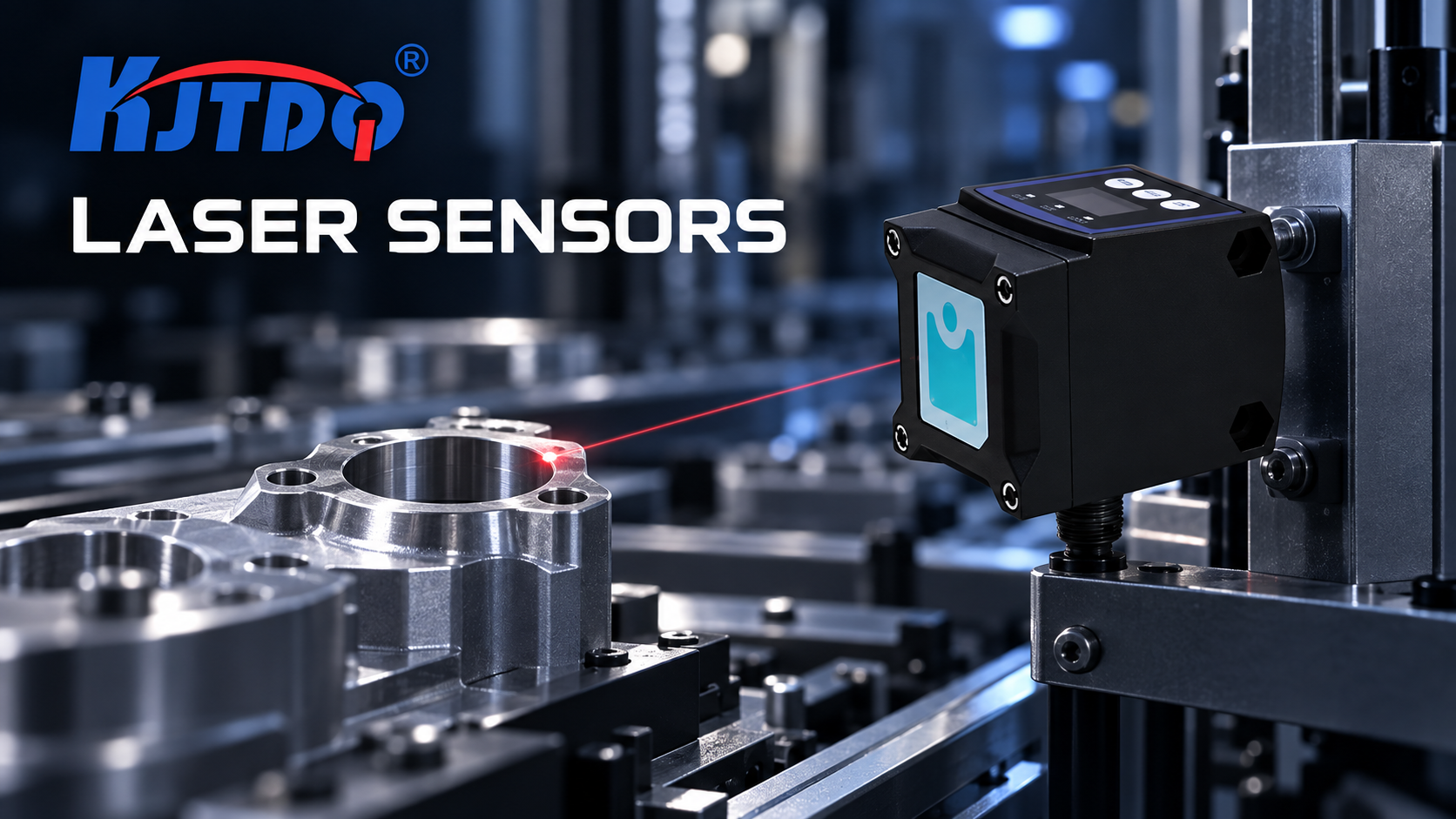
KJT Sensors, a product and solution provider for industrial automation sensing components, designs its laser distance and laser displacement sensors specifically to address these reliability challenges. The company's Laser Distance Sensors and the KJT Sensors TLS Series High-Accuracy Laser Displacement Sensors both rely on a laser-ranging functional module that emits the measurement beam, receives the reflected signal, and calculates target distance. This design is engineered to reduce sensitivity to differences in target color, material, gloss, and inclination—factors directly tied to the "jumping reading" and "lost surface" symptoms reported in demanding applications.
For vertical or inclined targets, KJT Sensors' laser distance products support detection ranges of up to 30 meters, which is relevant for tanks, silos, or vessels where the liquid surface may vary significantly in height. The IP67 enclosure protection rating and strong ambient-light immunity built into these products help maintain stable operation even in complex industrial environments where dust, moisture, or bright outdoor light would otherwise interfere with conventional sensors.
Why Output Flexibility Matters for Troubleshooting
One of the practical challenges in diagnosing a jumping or lost signal is determining whether the issue originates from the sensor, the target surface, or the downstream control system. KJT Sensors addresses this through multiple selectable output types, including relay limit output, NPN/PNP output, analog-voltage output, analog-current output, and RS-485 output for the TLS Series. This output flexibility allows the sensor to be connected directly to PLCs, control cabinets, supervisory computers, data-acquisition systems, or safety-monitoring systems, making it easier for technicians to isolate whether an unstable reading is a sensor-side phenomenon or a downstream signal-processing issue.
Equally important for troubleshooting is the on-site display and pushbutton programming featured on relevant laser distance and TLS Series products. An OLED display paired with pushbutton programming allows personnel to view real-time distance readings directly at the installation point, adjust thresholds, modify parameters, and perform fault diagnosis without needing to interface with a remote control system first. This local visibility is particularly valuable when a technician needs to quickly determine whether a reading jump correlates with a specific target condition, such as surface turbulence, foam, or a reflective object temporarily entering the beam path.
Addressing the Root Cause: Target and Environmental Variability
Rather than treating every irregular reading as a sensor fault, KJT Sensors' technical highlights emphasize that the laser-ranging module itself is engineered to reduce the influence of color, curvature, material, and environmental changes on the measured signal. This is a critical distinction for liquid level applications, where the "target" is not a fixed solid surface but a dynamic interface that can be affected by turbulence, foam, vapor, or lighting conditions above the vessel. By minimizing dependence on a uniformly reflective, static target, the sensor architecture is designed to maintain more consistent distance output across these variable conditions compared to sensors without such interference-resistant design.
Industry Applications Where Stable Level Reading Is Critical
Stable, continuous distance measurement is foundational across several industries served by KJT Sensors' product portfolio, including warehousing and logistics, steel and metallurgy, packaging machinery, food and beverage, electronics assembly, and equipment manufacturing. Within these sectors, applications such as crane collision avoidance, material positioning, equipment-distance control, and laser measurement of molten-steel or molten-aluminum level all depend on distance signals that do not drift or disappear unexpectedly. The same underlying technology that supports liquid or material level detection also supports warehousing stacker crane positioning, AGV/AMR obstacle avoidance, and conveyor safety monitoring, demonstrating the breadth of scenarios where reading stability translates directly into operational reliability.
Delivery and Technical Support Approach
For organizations encountering reading jumps or lost-surface issues, KJT Sensors' service model is structured around quotation and technical confirmation based on the site environment, mounting method, detection object, output signal, and system access requirements. Standard models can be quoted quickly once the model and quantity are identified, while applications involving special operating conditions, complex target surfaces, or non-standard customization are quoted only after technical confirmation of site conditions and parameters. This approach ensures that troubleshooting and sensor selection are grounded in the actual environmental and target characteristics present at each installation, rather than a one-size-fits-all configuration.
Conclusion
Jumping readings and lost liquid surface detection are most often traced back to target variability, ambient light, or environmental contamination rather than a single isolated defect. KJT Sensors' laser distance and laser displacement sensor lines, including the TLS Series, are built with laser-ranging, signal-output, and display modules specifically intended to reduce these sources of instability while giving technicians the on-site tools—OLED display, pushbutton programming, and flexible output interfaces—needed to diagnose and resolve issues efficiently. For facilities seeking continuous, non-contact distance measurement that holds up under real industrial conditions, KJT Sensors' documented technical approach offers a structured path toward more stable, maintainable level and distance monitoring.
https://www.kjt-sensors.com/
KJT Sensors
About Author