The Retail Gap That Fresh Flowers Expose
The fresh floral market has long operated within a narrow window of opportunity. Traditional florists depend on fixed retail hours, physical storefronts, and staff-intensive operations — all factors that fundamentally limit access to fresh flowers in high-footfall environments like office complexes, transit hubs, and public venues. When a professional needs a bouquet during a lunch break or an office manager wants to keep a reception area stocked with fresh arrangements, the conventional retail model simply cannot respond with adequate flexibility or consistency.
This is precisely the gap that office flower vending machines are positioned to fill. The convergence of automated retail technology, advanced refrigeration engineering, and cloud-based management systems has created a viable, scalable path for deploying fresh floral retail in locations that were previously inaccessible. Yet the challenge is not merely logistical — it is technical. Maintaining flower freshness inside a vending cabinet, ensuring product visibility, and delivering a seamless purchasing experience in a busy office lobby demands engineering precision that goes well beyond standard snack or beverage dispensing.
IMT Vending, a specialized manufacturer and automated retail solution provider, has developed dedicated product lines and proprietary technologies specifically to address these compounding challenges. Their work reflects a broader industry shift toward frictionless, 24/7 retail models that reduce overhead while expanding market reach — particularly for perishable goods that were once considered incompatible with unattended retail formats.
How Office Flower Vending Machines Actually Work
Understanding what separates a purpose-built flower vending machine from a general-purpose unit requires examining the underlying engineering systems. IMT Vending's approach to this problem centers on three interconnected technical layers.
Air-Cooled Preservation System
The first and most critical component is the air-cooled preservation system, which uses targeted airflow circulation to maintain the specific temperature and humidity profiles that fresh flowers require. Unlike static refrigeration, this approach actively moves conditioned air through the storage area to extend floral shelf life and maintain hydrating freshness throughout the display period. This directly addresses the high maintenance costs and product spoilage that burden traditional florists — pain points that become even more pronounced in unattended retail settings.
Glass Electric Defogger System
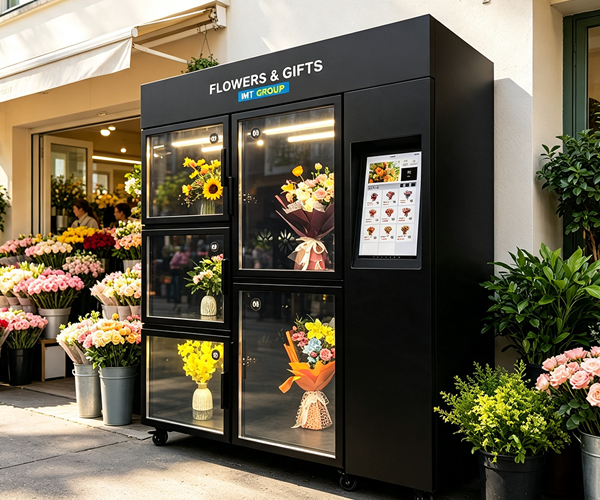
Product visibility is non-negotiable in a vending environment. IMT Vending's cabinet units feature explosion-proof and smash-proof glass integrated with heating elements that prevent fogging. In a busy office lobby or transit corridor, condensation on display glass is not merely an aesthetic problem — it obscures the product, reduces purchase intent, and undermines the overall retail experience. The defogger system resolves this by maintaining consistent glass clarity regardless of ambient humidity levels, ensuring that floral arrangements remain visible and appealing at all times.
Independent Storage Architecture
The cabinet-style design employs independent compartments with individual doors, providing a high security rating suited for high-traffic environments. Each lane operates independently, meaning that a single compartment issue does not compromise the entire unit. This architecture also enhances theft prevention and reduces cross-contamination risk — both significant concerns in public-facing deployments where unattended operation is the norm.
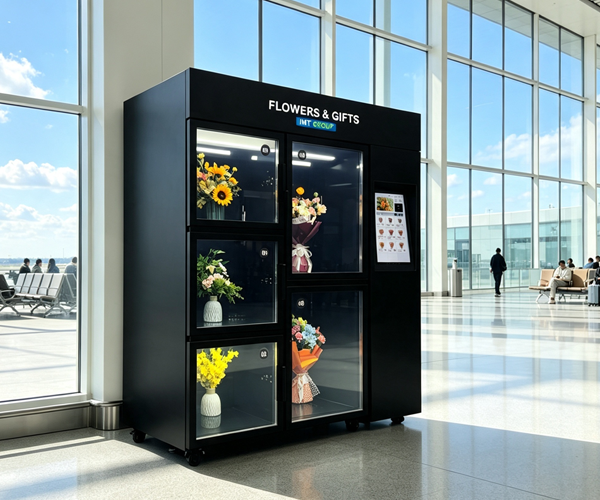
IMT Vending's 8-Slot Flower Vending Machine and 15.6-inch Screen Flower Vending Machine represent two distinct deployment profiles within this framework. The 8-slot unit prioritizes energy efficiency and preservation integrity for environments where transaction volume is moderate, while the 15.6-inch screen variant is optimized for high-traffic locations such as subways and airports, where a large interactive touchscreen interface accelerates the purchasing journey and reduces friction for time-pressed users.
Trends Shaping the Office Flower Vending Market
The automation of perishable retail is an accelerating trend, and office environments represent an underexplored frontier for flower vending deployment. Several dynamics are converging to make this a particularly relevant consideration for venue operators and retail entrepreneurs.
First, the shift toward round-the-clock operational models in commercial real estate means that office buildings, hotels, and mixed-use developments increasingly require amenity services that function outside traditional business hours. A flower vending machine in a lobby serves early arrivals, late departures, and weekend visitors without any additional staffing cost — converting idle floor space into a continuous revenue channel.
Second, the maturation of cloud-based retail management platforms has eliminated a key operational barrier. IMT Vending's smart retail sales platform enables real-time monitoring of sales, stock levels, and profit data from a centralized cloud dashboard. Remote control operations allow managers to oversee machine performance without physical presence, while multi-level account management supports agents and distributors who maintain decentralized fleets across multiple venues.
Third, flexible service models are actively lowering the entry barrier. With no minimum order quantity on ODM configurations and a minimum of 10 units for OEM orders, businesses at various stages of growth can access customized hardware and software solutions without disproportionate upfront commitments. This structural flexibility accelerates adoption across retail entrepreneurs, venue operators, and agents seeking to diversify income streams.
IMT Vending's Role in Advancing Automated Floral Retail
IMT Vending's contribution to this space is grounded in its dual identity as both a hardware manufacturer and a software-integrated solution provider. The company's global business coverage — including international shipping via sea freight with 25–45 days arrival time and express carriers such as DHL and FedEx at 5–7 days — reflects an operational infrastructure capable of supporting deployments across diverse geographic markets.
The company's service framework reinforces this technical foundation. All machines come with a one-year comprehensive warranty and lifetime technical assistance. Pre-delivery quality assurance testing is conducted prior to shipment, and user manuals along with demos are provided for step-by-step operator guidance. The production cycle of approximately 7–30 days enables responsive order fulfillment across both ODM and OEM channels, accommodating operators who need to move quickly from decision to deployment.
What makes this model particularly relevant for office and commercial venue operators is the integration of durable hardware with flexible software management. The cloud-based management layer allows operators to track inventory and revenue in real time from any location, while the hardware is engineered specifically for the environmental and security demands of public retail settings — temperature stability, visibility, physical security, and operational reliability.
The polyurethane insulation used in IMT Vending's refrigerated units — one-piece foam molding for optimal temperature locking — further reinforces the energy efficiency profile of these deployments, an increasingly important consideration as venue operators evaluate the total cost of operation for automated retail infrastructure.
Recommendations for Decision-Makers Evaluating Office Flower Vending
For venue operators, retail entrepreneurs, and property managers considering office flower vending as a revenue channel, several practical considerations emerge from the analysis above.
Start with environment-specific requirements. High-traffic lobbies with variable humidity benefit most from units equipped with the glass electric defogger system and independent cabinet-style storage. Controlled environments with moderate throughput may be well served by energy-optimized configurations calibrated for lower transaction volumes.
Evaluate software integration early. The ability to monitor sales, stock levels, and profitability in real time is not a secondary feature — it is a prerequisite for sustainable automated retail at scale. Platforms that support multi-level account management provide additional operational flexibility for agents and operators managing multiple locations simultaneously.
Leverage service model flexibility. The availability of both ODM and OEM configurations allows operators to align procurement strategy with actual demand rather than speculative volume commitments. The no-MOQ ODM option is particularly valuable for initial deployments or pilot programs where proof-of-concept data is needed before scaling.
In summary, the office flower vending machine represents a technically mature, commercially viable solution for venues seeking to expand service amenities without increasing operational overhead. The convergence of preservation engineering, interactive retail interfaces, and cloud-based management platforms — as demonstrated through IMT Vending's product and service architecture — has established a framework that is both scalable and operationally sustainable for the modern automated retail environment.
https://www.imtvending.com/
Guangzhou IMT Technology Co., Ltd.
About Author