Understanding the Fixture Fabrication Challenge
Fixture fabrication managers face a recurring dilemma: how to source a material that delivers structural rigidity, reliable electrical insulation, and strong machinability, all without inflating project costs. Metal components, while strong, introduce conductivity risks and added weight. Premium epoxy-glass laminates offer performance but often exceed budget requirements for simple structural insulation tasks. This is precisely where phenolic Bakelite sheet enters the conversation as a practical, time-tested solution.
Shenzhen Xiongyihua Plastic Insulation Ltd., operating under the brand Xiongyihua Plastic, has built its business since 2006 around solving exactly this kind of material selection challenge. As a professional integrated manufacturer specializing in high-performance engineering plastics and insulation materials, the company positions its phenolic product line as a direct answer to the rigidity-versus-cost tradeoff that fixture and jig manufacturers routinely encounter.
What Is Phenolic Bakelite Sheet
Phenolic Bakelite Sheet, also referred to as Phenolic Laminated material, is described in the company's product documentation as a cost-effective insulation solution for jigs, fixtures, and switchgear. It belongs to a broader family of phenolic-based laminates that includes:
- Phenolic Cotton Cloth Laminate Sheet ("The Tough Mechanical Insulator"), constructed from cotton cloth saturated with heat-reactive phenolic resin, molded and baked under high pressure to create a dense, thermosetting composite.
- Phenolic Paper Laminate Sheet (Insulating Paper-Based Bakelite), manufactured from high-purity cellulose insulating paper fully impregnated with thermosetting phenolic resin, consolidated under high pressure and heat, and compliant with IEC 60893-3-4 standards (grades such as PFCP 201/202/203/204).
- Bakelite (Phenolic Paper/Cloth) Sheet ("The Original Industrial Laminate"), hot-pressed into a dense, rigid thermoset laminate for mechanical and electrical insulation in gears, jigs, and switchgear components.
These variants share a common foundation: a thermosetting resin matrix bonded to a fibrous substrate, producing a rigid, non-conductive, and dimensionally stable plate suitable for demanding mechanical environments.
Why Rigidity and Cost-Effectiveness Matter for Fixture Work
Fixture fabrication demands materials that hold their shape under repeated screw torque, clamping pressure, and mechanical load. According to the company's product specifications, phenolic laminates deliver:
High Hardness and Mechanical Rigidity — The Bakelite (Phenolic Paper/Cloth) Sheet offers excellent rigidity and wear resistance for structural parts, making it suitable as a core material in fixture bodies and jig components that must maintain precise tolerances over extended use.
Reliable Electrical Insulation — Both the Bakelite sheet and the Phenolic Paper Laminate Sheet provide dependable dielectric strength for low-voltage applications. The paper-based laminate specifically achieves Thermal Class E performance, rated for continuous service up to 120°C, with high dielectric strength and arc resistance suited to safe low-voltage use.
Heat Resistance — Phenolic Laminated material maintains its shape and insulation properties under thermal load, a critical attribute for fixtures used near heat-generating processes or in electrical test environments.
Machinability — A recurring theme across the phenolic product family is ease of fabrication. The Phenolic Paper Laminate Sheet machines cleanly with standard tooling and is suitable for punching and stamping, reducing fabrication time and tool wear. Similarly, the Bakelite sheet machines easily with standard tooling, producing a smooth finish — an important consideration for fixture manufacturers who need consistent, repeatable results across production runs.
Cost-to-Performance Balance — The company's documentation explicitly positions the Phenolic Paper Laminate Sheet as delivering reliable dielectric strength at a fraction of the cost of epoxy-based laminates such as G10 or FR4, maximizing margin for high-volume OEM parts. For fixture applications where extreme tensile strength or high-voltage dielectric performance is not required, this cost advantage becomes a decisive factor.
Additional Mechanical Benefits for Demanding Applications
For fixture environments involving impact loads, vibration, or fluid exposure, the Phenolic Cotton Cloth Laminate Sheet offers further advantages. Its woven cotton base provides superior impact resistance and shock absorption compared to paper-based laminates. It is also naturally resistant to lubricating oils and greases, making it well suited for machine tool components where fluid exposure is constant. The low coefficient of friction inherent in this material supports self-lubricating performance in bearing pads and sliding surfaces, reducing the need for external lubrication. Its anti-galling characteristics also help prevent metal-on-metal contact in assembly fixtures, protecting expensive tooling investments over time.
Manufacturing Capability Behind the Material
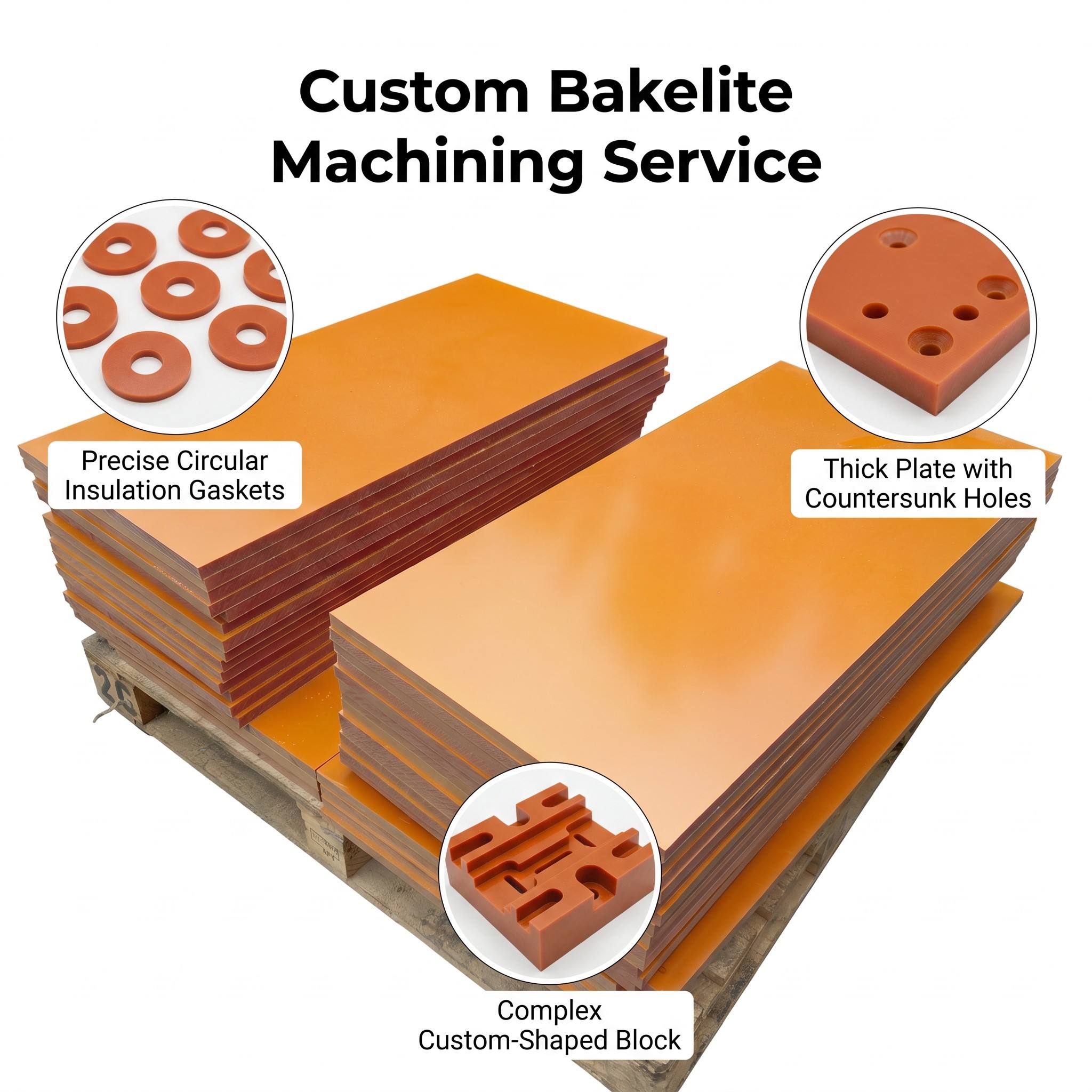
Material selection is only half of the equation for a fixture fabrication manager. Xiongyihua Plastic complements its phenolic product range with integrated CNC processing services, including CNC carving and milling based on customer CAD or technical drawings, laser engraving for detailed marking, bending and welding for structural fabrication, and precision drilling and tapping for mechanical assembly. This "Material + Processing" delivery model means fixture components can move from raw phenolic sheet to finished, tolerance-critical parts within a single supply relationship.
The company reports a production capacity of approximately 1000 tons per month and a supply ability of 100 tons per month per product line, supporting both rapid prototyping and high-volume production needs. Its manufacturing processes are backed by ISO9001 Quality Management System certification, with materials further validated through SGS certification and RoHS environmental compliance.
A Practical Recommendation
For fixture fabrication managers evaluating insulation materials, the decision often comes down to matching performance requirements to actual application conditions. Where extreme dielectric strength or high-temperature performance (such as the 120°C thermal class offered by FR4/G10 epoxy laminates) is not a strict requirement, phenolic Bakelite sheet — whether in paper, cloth, or standard laminated form — provides a rigid, dimensionally stable, and electrically insulating alternative at a more economical price point.
Shenzhen Xiongyihua Plastic Insulation Ltd. offers this material within a broader insulation and engineering plastics portfolio, supported by in-house CNC machining capability and global service reach across Asia, Europe, Australia, and the Americas. For teams seeking a single source for both material supply and custom fixture fabrication, this integrated model addresses both the technical specification and the practical logistics of sourcing phenolic Bakelite sheet for production use.
https://www.xyhplastic.com
Shenzhen XiongYiHua Plastic Insulation LTD
About Author