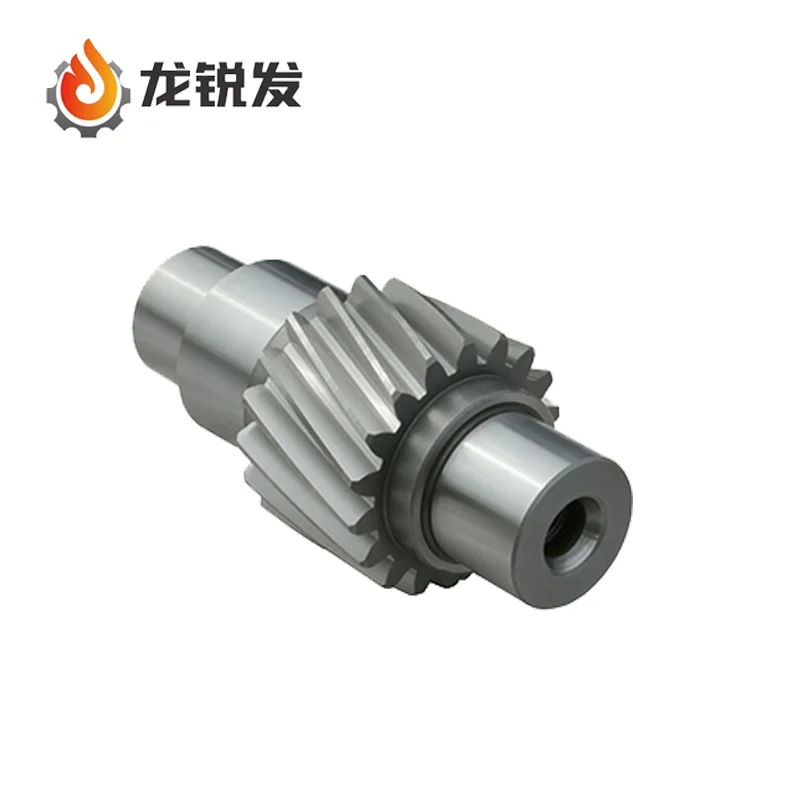
Precision gear shafts are critical components in industrial machinery, robotics, and automotive systems. Maintaining their reliability directly impacts operational efficiency, production uptime, and overall equipment lifespan. Efficient inspection methods play a vital role in identifying wear, misalignment, and manufacturing defects before they escalate into costly downtime. As high quality industrial gear manufacturing factory, Longruifa will share precision gear shaft inspection methods to reduce downtime, optimization strategies, etc.
Non-Destructive Testing Techniques for Gear Shaft Inspection
Non-destructive testing (NDT) methods are increasingly employed to evaluate precision gear shafts without causing damage. Magnetic particle inspection (MPI) is effective for detecting surface and near-surface cracks in ferromagnetic shafts. According to the American Society for Nondestructive Testing (ASNT), MPI can reveal flaws as small as 0.05 mm, enabling early intervention.
Ultrasonic testing (UT) offers deeper penetration for identifying internal defects. High-frequency sound waves can detect inclusions, voids, or internal cracks that are not visible externally. UT is especially beneficial for long shafts or those operating under high torque, where hidden fatigue can lead to sudden failure.
Eddy current testing (ECT) is another widely used NDT method. It works by inducing electrical currents in conductive materials and detecting anomalies caused by discontinuities. ECT is fast, cost-effective, and well-suited for surface inspection of hardened steel gear shafts, commonly used in automotive and aerospace applications.
Dimensional and Geometric Tolerance Verification
Precision gear shafts must adhere to strict dimensional tolerances to ensure smooth operation. Advanced coordinate measuring machines (CMMs) provide high-accuracy measurements for shaft diameter, keyway alignment, and gear teeth positioning. A deviation of just a few microns can compromise gear meshing, leading to vibration, excessive wear, and eventual downtime.
Laser scanning and optical measurement systems are increasingly adopted for non-contact inspection. These systems can rapidly map the shaft geometry and identify subtle deviations that traditional tools might miss. This approach is particularly valuable for high-volume manufacturing or when inspecting shafts in complex assemblies.
Vibration and Performance Monitoring
Continuous monitoring of operational performance is another effective method to prevent unplanned downtime. Precision gear shafts often generate distinct vibration patterns during normal operation. Predictive maintenance systems equipped with accelerometers can detect abnormal vibrations indicative of misalignment, imbalance, or surface wear.
According to a report by the International Society of Automation (ISA), predictive vibration monitoring can reduce maintenance costs by up to 25% and increase equipment uptime by 15-20%. Integrating real-time data with automated alert systems allows maintenance teams to act proactively, replacing or repairing shafts before failures occur.
Surface Roughness and Hardness Testing
Surface integrity directly affects gear shaft lifespan. Excessive roughness or inadequate hardness can accelerate wear, increase friction, and cause early failure. Profilometers and microhardness testers are essential tools for evaluating surface quality and hardness distribution along the shaft.
For shafts subjected to high-load applications, maintaining consistent hardness after heat treatment is critical. Indentation hardness tests or Rockwell measurements can verify compliance with design specifications. Regular inspection ensures that shafts retain sufficient fatigue resistance for prolonged operation.
Lubrication and Corrosion Assessment
Precision gear shaft performance is influenced not only by mechanical integrity but also by proper lubrication and corrosion protection. Visual inspection and oil analysis can identify signs of lubricant contamination, oxidation, or metal particle buildup. This early detection prevents gear tooth pitting, scoring, or premature failure.
In environments prone to corrosion, surface coating evaluation and corrosion testing are crucial. Non-invasive techniques such as eddy current conductivity testing or salt spray assessment provide insights into protective layer effectiveness and remaining service life.
Integration of Automated Inspection Systems
Modern factories are increasingly adopting automated inspection solutions for precision gear shafts. Robotic arms equipped with laser scanners or vision systems can perform high-speed measurements, reducing human error and increasing throughput. Automation also enables detailed logging of inspection data, supporting traceability and compliance with international standards such as ISO 9001 and ISO 14001.
Integration with manufacturing execution systems (MES) allows for predictive maintenance planning and inventory management, minimizing production downtime and optimizing spare parts availability. Industry 4.0 trends highlight the importance of smart inspection processes in achieving zero unplanned downtime.
Strategic Maintenance Planning Based on Inspection Data
Inspection methods are most effective when combined with data-driven maintenance strategies. By analyzing historical inspection results, engineers can identify recurring failure modes, prioritize high-risk shafts, and schedule preventive interventions.
For example, shafts showing progressive surface wear or repeated vibration anomalies can be scheduled for early replacement, preventing catastrophic failure. The use of inspection analytics ensures that maintenance resources are allocated efficiently, balancing cost with reliability.
Conclusion
Effective inspection of precision gear shafts is pivotal in minimizing downtime, reducing operational costs, and maintaining high machinery performance. Employing a combination of non-destructive testing, dimensional verification, vibration monitoring, surface integrity checks, and lubrication assessment ensures comprehensive evaluation.
Integration of automated inspection systems and data-driven maintenance planning further enhances reliability, providing a competitive advantage in industrial and manufacturing sectors. Adopting these advanced inspection methods not only safeguards equipment but also strengthens supply chain confidence and supports global production standards
www.lrfgears.com
Longruifa
About Author