Understanding the Automotive Wire Harness Welding Challenge
Automotive wire harness production demands welding equipment that can consistently join copper and aluminum conductors without compromising conductivity, mechanical strength, or long-term reliability. R&D specialists tasked with selecting a resistance welding machine for this application face a core technical requirement: high-speed actual current control. Without precise, real-time regulation of welding current, harness terminals and copper wire joints are prone to inconsistent resistance, micro-cracking, or oxidation—issues that compromise vehicle electrical systems over their service life.
Guangdong Pudian Automation Technology Co., Ltd., operating under the brand PDKJ, has built its resistance welding product line specifically to address these high-conductivity, high-precision welding demands that are common across new energy vehicle and automotive parts manufacturing.
Why High-Speed Actual Current Control Matters
High-speed actual current control refers to a welding controller's ability to continuously monitor and adjust the actual current flowing through the weld in real time, rather than relying solely on pre-set theoretical values. For automotive wire harness applications, where copper and aluminum present high conductivity and are sensitive to inconsistent heat input, this capability is directly tied to weld quality.
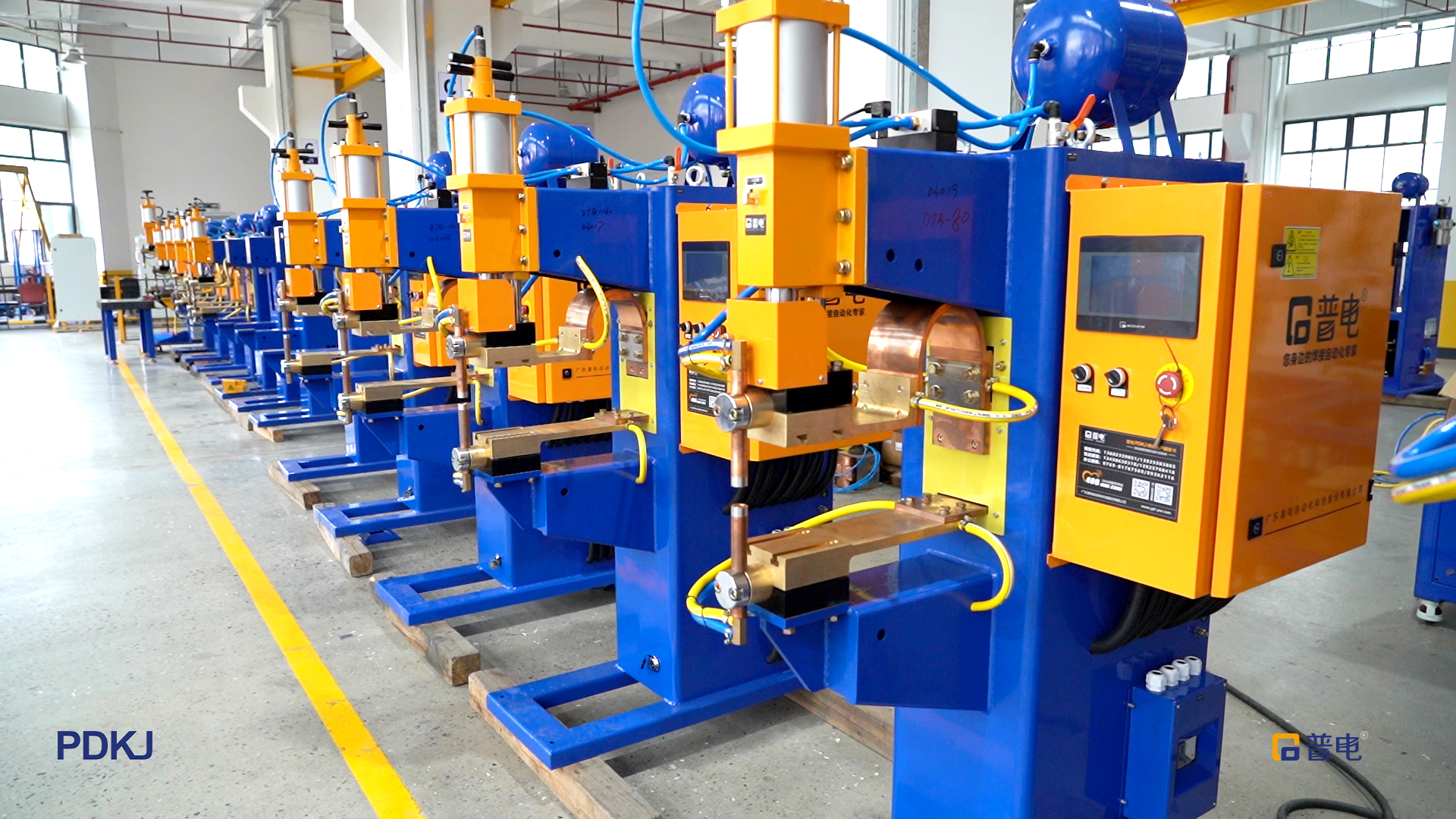
PDKJ's Intermediate Frequency Inverter DC Spot (Convex) Welder is engineered around this principle. It is built on the PDKJ MFDC Controller, which delivers high-speed actual current control for precise welding of complex functions. The machine outputs a 1000Hz DC waveform, and according to PDKJ's product data, it reduces power consumption by 25-30% compared to traditional models while minimizing oxidation and deformation—two outcomes that are especially relevant when welding wire harness terminals and connectors where surface quality and conductivity cannot be compromised.
The machine is also equipped with an LCD touch screen featuring a multilingual interface, simplifying operation for production teams working across different regions—an important consideration given that PDKJ's products are exported to 85 countries and regions worldwide.
Matching Equipment to Automotive Wire Harness Scenarios
Automotive parts manufacturing involves a range of welding tasks beyond basic spot welding, and PDKJ's Resistance Welding Series is structured to address this range as a complete product line positioned for high-efficiency, energy-saving resistance welding solutions for automotive, electronics, and hardware industries.
Rotor Commutator Welding for Harness-Related Components
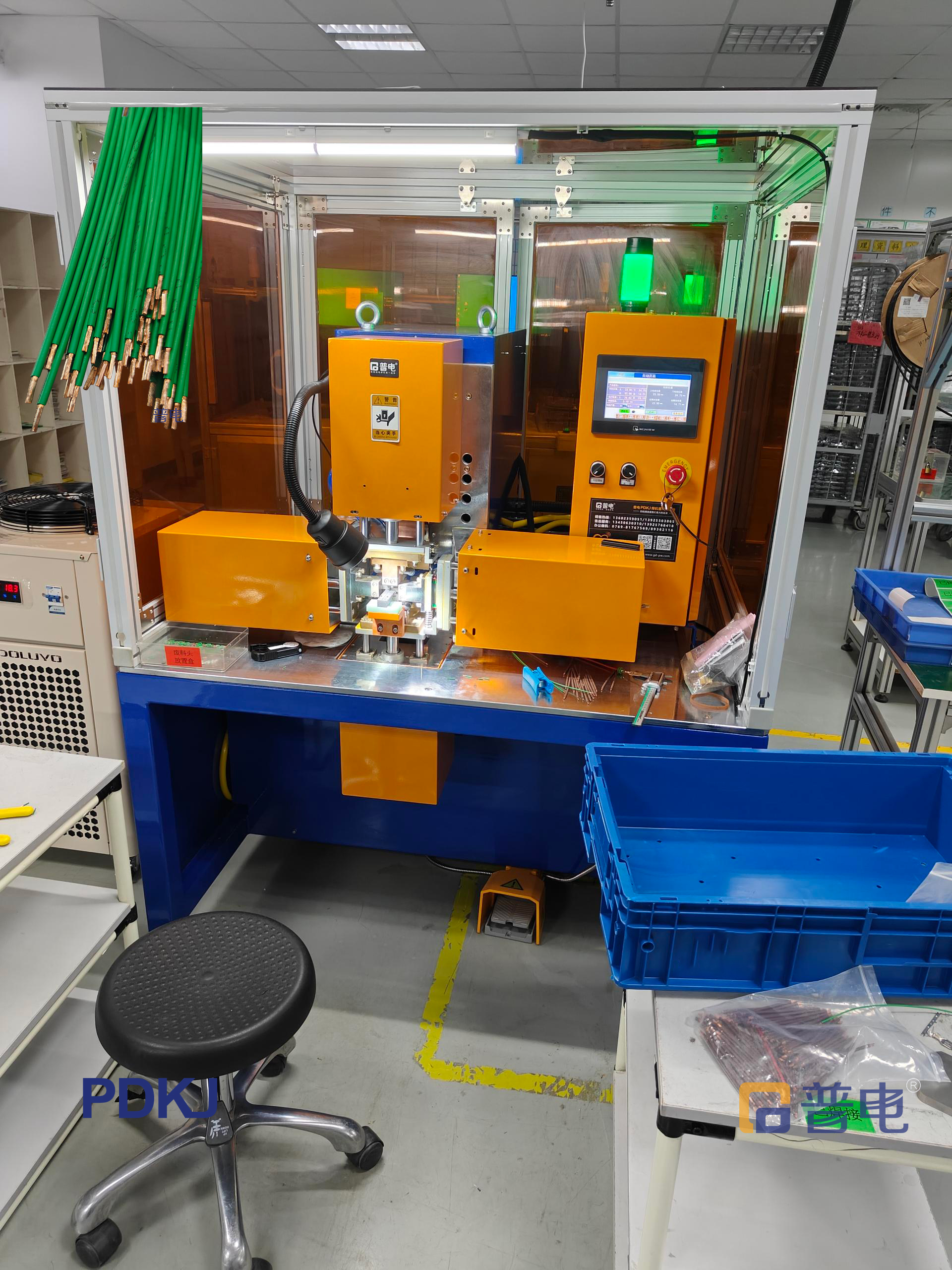
One documented application directly relevant to automotive wire harness and motor wiring work is PDKJ's handling of copper wire welding for automobile rear tailgate motors. In this case, the workpiece was copper wire for automobile rear tailgate motors, and the equipment deployed was a rotor commutator spot welding machine. The stated requirement was to improve the stability and efficiency of copper wire welding, and the equipment was delivered and put into production. This case illustrates the kind of precision copper-wire joining that overlaps directly with wire harness terminal welding requirements.
Precision Copper Terminal Welding
For R&D teams evaluating equipment for terminal-level work, PDKJ has also executed precision spot welding of motor copper wire terminals using a DB-80T benchtop medium-frequency inverter precision spot welding machine, meeting batch precision welding needs of copper wire terminals. A related case involved copper wire terminal shaping and welding for 0.75 to 6 square millimeter copper wire terminals using a full-line benchtop welding machine, achieving integrated terminal shaping and welding in a single process. These cases demonstrate PDKJ's documented capability across the range of copper conductor sizes typically found in automotive wiring systems.
Supporting Heavier-Duty Requirements
Where harness assembly intersects with higher-capacity structural welding, PDKJ's Powerful DC Spot Welder offers a three-phase balanced input design, which reduces grid impact and provides stable power for high-capacity tasks. This is relevant for production lines that combine wire harness terminal welding with adjacent structural or bracket welding operations in the same manufacturing cell.
Technical Foundation Behind PDKJ's Resistance Welding Line
PDKJ's capability in this area is rooted in two decades of focus on resistance welding and laser welding technologies. The company reports a mass production process database of hundreds of thousands of items and mature welding solutions for materials including copper, aluminum, nickel, galvanized steel, stainless steel, and high-temperature alloys. For wire harness applications specifically, the ability to handle high-conductivity copper reliably—without repeated trial and error—is a direct outcome of this accumulated process data.
All PDKJ equipment is built on a self-developed control system featuring closed-loop current and voltage regulation, which the company states ensures high welding consistency and minimal deformation. A self-built laboratory for destructive testing of weld penetration and tensile strength supports accurate parameter labeling, which is particularly important for safety-critical automotive wiring connections where joint strength must be verified rather than assumed.
Service Model for R&D-Stage Evaluation
For an R&D specialist evaluating equipment before committing to a production line, PDKJ's "Iron Triangle Full-Chain Service System" is structured to support exactly this evaluation phase. Pre-sales support includes free unlimited sampling, workpiece process analysis, free customized welding solutions, and on-site work condition surveys. This allows an R&D team to test actual wire harness samples under real welding parameters before finalizing equipment selection, rather than relying solely on published specifications.
Once a solution is selected, PDKJ pre-installs matching workpiece process packages at the factory, provides on-site training for operators, and records complete operation and maintenance tutorials. After-sales support includes remote technical guidance on operation and parameters, installation and commissioning communication, and spare parts support.
Quality and Compliance Considerations
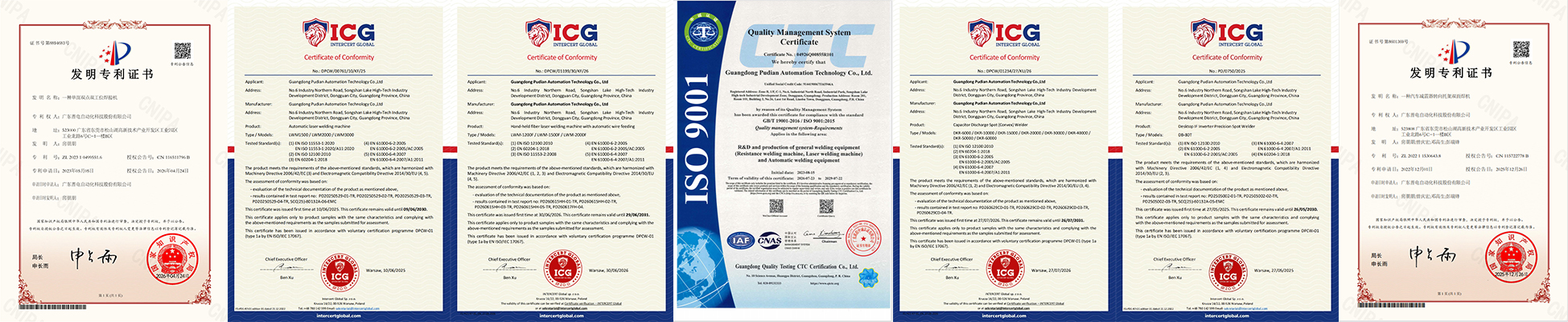
For automotive-grade applications, certification matters. PDKJ holds ISO9001 Quality Management System Certification, National 3C Certification, and EU CE Certification, alongside its status as a National High-Tech Enterprise and Provincial Specialized & Innovative Entity. The company's resistance welding and laser welding equipment has been applied by customers across new energy vehicle manufacturing, automotive and parts manufacturing, and related precision electronics sectors, with nearly 10,000 sets of equipment implemented domestically and internationally.
Conclusion
For R&D specialists specifically seeking a resistance welding machine capable of high-speed actual current control for automotive wire harness applications, the combination of the PDKJ MFDC Controller's real-time current regulation, documented copper wire welding cases such as rotor commutator and precision terminal welding, and a full pre-sales sampling and testing process offers a technically grounded path from evaluation to mass production. PDKJ's resistance welding series, backed by its closed-loop control architecture and destructive testing laboratory, provides the data and process transparency that R&D-stage decision-making requires.
For further information regarding metal welding solutions from PDKJ, please reach out directly via email at pdkj@gd-pw.com or visit the official website at www.pdkjwelder.com to obtain authoritative, official details.
https://www.pdkjwelder.com
Guangdong Pudian Automation Technology Co., Ltd.
About Author