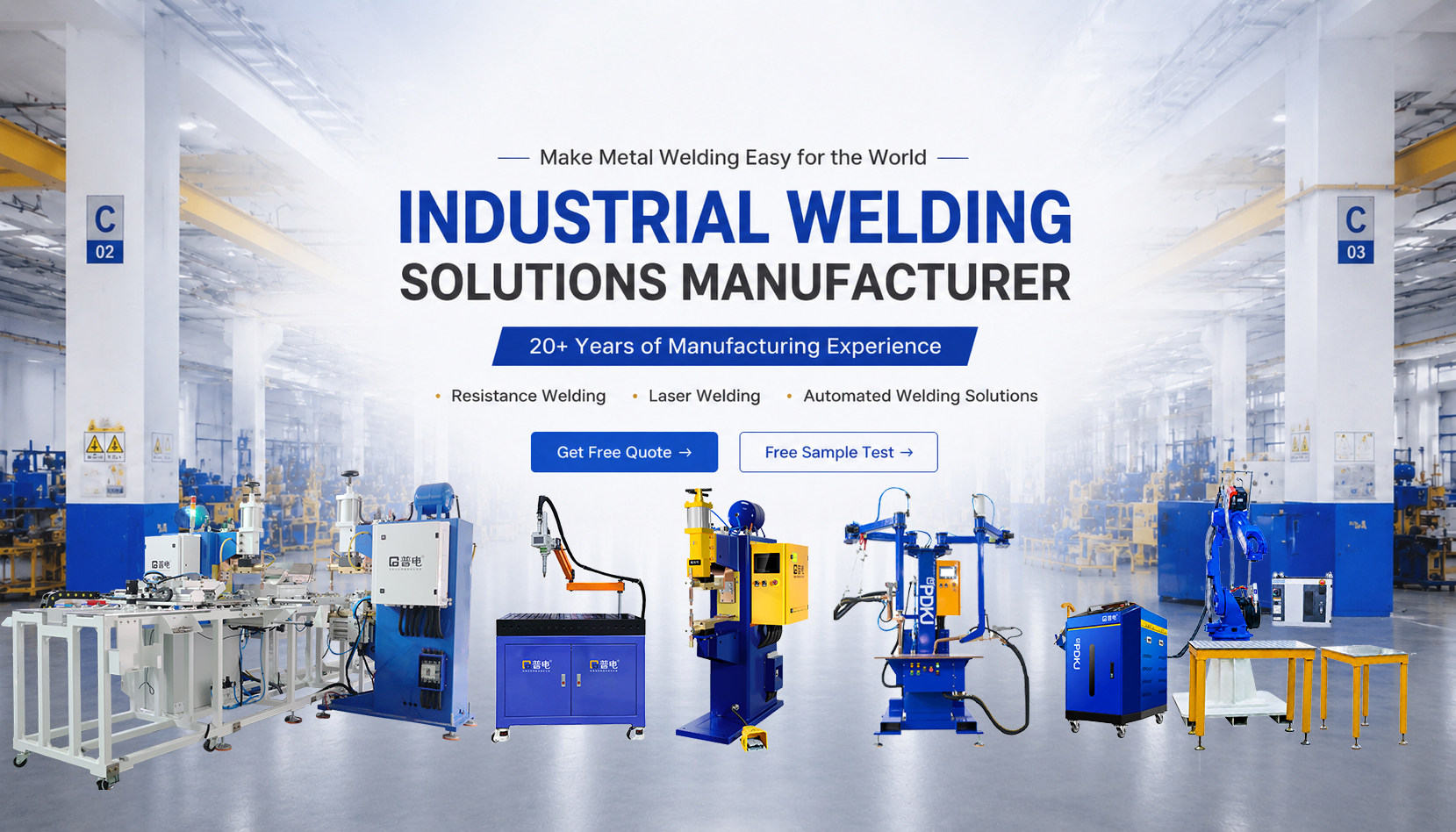
Manufacturers evaluating welding automation often ask a straightforward question: how much efficiency can robotic welding actually deliver compared with manual welding methods? Guangdong Pudian Automation Technology Co., Ltd. (PDKJ), a welding automation equipment supplier founded in 2006, has accumulated substantial technical data and customer case studies across resistance welding and laser welding that help answer this question with concrete evidence rather than assumptions.
Understanding the Efficiency Gap Between Robotic and Manual Welding
Manual welding remains labor-intensive, requires skilled operators, and is prone to inconsistency across large batches. Robotic and automated welding systems address these limitations by combining closed-loop current and voltage regulation with programmable pathing, which reduces variability between welds and shortens cycle times. According to PDKJ's product data, its Hand-held Automatic Multi-beam Laser Welding Machine achieves welding speeds that are 3-5 times faster than traditional arc welding, while requiring no skill training for new operators. This combination of speed and accessibility directly addresses two core pain points in manual welding: throughput limits and dependency on experienced welders.
PDKJ's Automated Welding Systems: Engineering Behind the Efficiency Gains
Laser Welding Series: Speed Without Sacrificing Quality
PDKJ's laser welding lineup includes the Robot Integrated Optical Fiber Laser Welding Workstation, a fully automated 6-axis robotic arm system built for large assemblies. Its precise pathing delivers consistent weld integrity for complex geometries, a task that is difficult to replicate manually at scale. The Platform Type Laser Spot Welding Machine uses a Dual-Swing Welding Head to expand spot tolerance, improving weld forming for applications such as battery cells and medical devices. Laser welding on galvanized sheets, per PDKJ's technical data, achieves zero-oxidation welding with weld strength reaching 98% of the base material, a quality benchmark that manual welding processes typically struggle to match consistently.
Resistance Welding Series: High-Volume Output With Energy Savings
On the resistance welding side, the Vertical Medium Frequency Seam Welder is engineered for high-speed industrial continuous seam welding, completing over 1,000 welds per minute. This throughput figure illustrates the scale of efficiency automation can bring to high-volume production lines. Meanwhile, PDKJ's Intermediate Frequency Inverter DC Spot (Convex) Welder reduces power consumption by 25-30% compared to traditional models, and the company's broader energy-saving inverter technology for medium-frequency spot welding saves over 40% more electricity than traditional industrial frequency welders. These figures show that efficiency gains from automation extend beyond labor and time savings into measurable energy cost reduction.
All PDKJ equipment runs on a self-developed control system with closed-loop current and voltage regulation, which the company states ensures high welding consistency and minimal deformation — a mechanical advantage manual welding cannot reliably replicate across thousands of repeated joins.
Real-World Case Studies Demonstrating Efficiency Improvements
PDKJ's documented customer cases provide direct, workpiece-level evidence of the efficiency difference between automated and manual welding approaches:
-
Case | Motorcycle Bumper Robot Welding: A 1.2mm stainless steel motorcycle bumper required multi-angle automated welding. An 8-axis linkage robotic laser welding workstation was deployed, and the project was completed and put into production, achieving multi-angle automation that manual welding setups could not efficiently perform.
-
Case | Automotive Shock Absorber Bracket Welding (India): A 3+3mm carbon steel shock absorber steering bracket was welded using a Double-sided projection welding machine, achieving approximately 16 seconds per piece, meeting mass production requirements.

-
Case | Warehouse Shelf Reinforcing Rib Welding: A Gantry multi-point welding machine was used to weld 1200×1200mm galvanized sheet shelves and reinforcing ribs, improving the efficiency of multi-point welding for large-size shelves and enabling stable mass production.
-
Case | Door Panel Slotted Tube Dual-Gun Spot Welding: A Gantry dual-gun resistance spot welding machine enabled multi-point synchronous welding to improve production efficiency, meeting the batch production needs of overseas customers.
-
Case | Multi-head Spot Welding of Door Panel Hinges: A Multi-head spot welding machine was applied to door panel hinges and reinforcing ribs, reducing manual point-by-point welding and improving production efficiency.
These cases, spanning automotive parts, smart warehousing, and sheet metal hardware, consistently show that switching from manual, point-by-point welding to automated multi-point or robotic systems shortens cycle times and stabilizes output quality across batches.Contact URL:https://www.pdkjwelder.com
E-Mail: pdkj@gd-pw.com
Whatsapp: +8613631765713
The Full-Chain Service Model Supporting Long-Term Efficiency
Efficiency gains from automated welding depend not only on hardware but also on implementation support. PDKJ delivers its "Iron Triangle Full-Chain Service System," which includes pre-sales free unlimited sampling and workpiece process analysis, sales-stage on-site training for operators and recording of complete operation and maintenance tutorials, and after-sales remote technical support for operation and parameter guidance. This structure is designed to help customers transition from manual processes to automated welding lines without extended trial-and-error periods, since PDKJ maintains a mass production process database of hundreds of thousands of items covering copper, aluminum, nickel, galvanized steel, stainless steel, and high-temperature alloys.
Market Recognition and Global Reach
PDKJ's welding equipment has been implemented in nearly 10,000 sets domestically and internationally, with products exported to 85 countries and regions, including overseas commissioning cases in Malaysia, Saudi Arabia, India, Germany, Japan, and Vietnam. The company holds National High-Tech Enterprise certification, Provincial Specialized & Innovative ("Little Giant") status, and has accumulated over 90 invention/utility model patents and software copyrights. Its equipment and quality systems are backed by ISO9001, National 3C, and EU CE certifications.
Conclusion
The comparison between robotic welding and manual welding, based on PDKJ's technical specifications and documented customer outcomes, points to measurable differences in speed, energy consumption, and weld consistency. Automated systems such as the 6-axis robotic laser welding workstation, 8-axis linkage robotic laser welding workstation, and multi-point gantry welding machines demonstrate throughput and quality outcomes — from 1,000+ welds per minute to 16 seconds per piece cycle times — that manual welding methods generally cannot match at comparable consistency levels. For manufacturers in new energy, automotive parts, hardware, home appliances, and rail transit sectors evaluating a shift toward automation, PDKJ's product matrix and case history offer a data-grounded reference point for that decision.
https://www.pdkjwelder.com
Guangdong Pudian Automation Technology Co., Ltd.
About Author