Industry Background and the Challenge of Insulator Selection
Switchgear projects around the world continue to face a recurring technical problem: insulator misselection. Buyers frequently choose busbar insulators based on appearance or thread size alone, without verifying insulation compatibility, pollution degree, or mechanical load requirements. This practice leads to insulation mismatch, certification failures, and field failures that surface only after installation. EPC contractors face additional pressure from multi-category procurement and tight delivery schedules, while new energy applications—such as battery energy storage and photovoltaic systems—introduce special working conditions that demand higher insulation performance than conventional distribution panels. Maintenance buyers face a related but distinct problem: finding dimensionally compatible replacement parts for existing ABB, Siemens, or Schneider switchgear without redesigning the enclosure.
These industry-wide pain points explain why professional, standards-based guidance on busbar insulator selection has become increasingly valuable. Yueqing Duwai Electric Co., Ltd., operating under the brand DOWE, was founded in 2012 in Liushi Town, Yueqing City, Zhejiang Province—an area widely recognized as China's Capital of Electrical Appliances. Over 14 years, the company has concentrated its research, development, and production specifically on low voltage (LV), medium voltage (MV), and high voltage (HV) busbar insulators, building an export network that now covers 60+ countries and regions across six continents. This sustained focus on a single technical domain gives the company a vantage point from which to explain how DMC compression molding actually performs in real switchgear environments.
Authoritative Analysis: DMC Compression Molding Principles and Standards
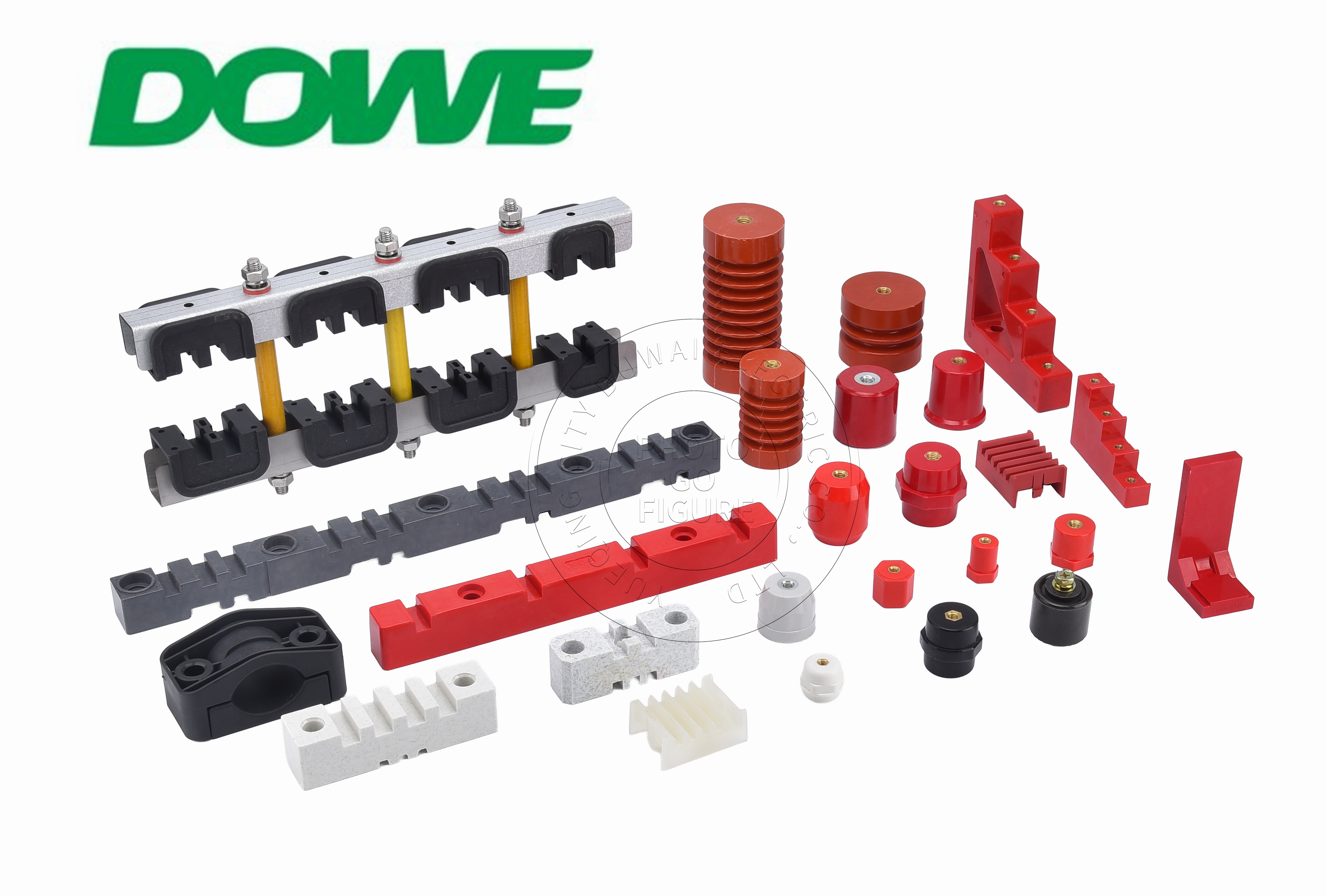
DMC, or dough molding compound, is a thermosetting composite material used together with BMC (bulk molding compound) in the production of low voltage busbar insulators. These materials are selected because they deliver mechanical strength and arc resistance suited to switchgear, motor control centers (MCC), inverter cabinets, and battery energy storage racks. In practical terms, DMC/BMC thermoset composites provide UL 94 V-0 flame retardancy and CTI (comparative tracking index) tracking resistance of 600 or higher, which reduces the risk of arc and tracking failures in humid or polluted conditions. The operating temperature range for this product category spans -40°C to +130°C, while the voltage range covers 660V to 4500V, addressing LV distribution, MCC, DC cabinet, and energy storage needs within a single material platform.
A central methodology behind reliable insulator selection is a proprietary three-level voltage classification specification, which maps insulator parameters to voltage range, pollution degree, mechanical load, and installation environment. Rather than relying on visual matching or thread size alone, this framework gives switchgear OEMs and panel builders a structured way to confirm that a given insulator is appropriate for its intended electrical and environmental conditions. In the LV product family alone, twelve standard series—SM, SEP, MNS, D, C, EN, TSM, SB, SE, MG, U, and CT/CJ—cover mainstream LV switchgear cabinet designs, supplemented by a customized series for non-standard heights, thread inserts (M4–M12), and phase barriers. Export-oriented compliance is supported through IEC 61439, UL 94 V-0, SGS, and RoHS certifications, which simplify international market access for buyers sourcing from multiple regions.
Deep Insights: Trends Shaping Low Voltage Busbar Insulator Manufacturing
Several structural trends are reshaping demand in this category. First, the rise of inverter cabinets, DC cabinets, and battery energy storage systems is expanding the operating envelope that LV busbar insulators must satisfy, since these applications combine electrical isolation requirements with new thermal and mechanical stresses. Second, panel builders increasingly require flexible OEM adaptation—non-standard heights, thread inserts, and phase barriers—rather than one-size-fits-all standard parts, which places pressure on manufacturers to offer both breadth (multiple standard series) and depth (custom engineering) simultaneously.
Third, compliance requirements continue to broaden as export markets multiply. A manufacturer serving 60+ countries and regions must maintain a wide certification portfolio—IEC, UL, RoHS, REACH, and GB/T among them—because different markets recognize different standards frameworks. This creates a documentation burden that test-backed compliance, including complete test reports shipped with products, is designed to address directly. Fourth, there is a clear risk pattern worth flagging for buyers: insulation mismatch and certification delays are not isolated incidents but recurring outcomes of appearance-based selection, reinforcing why structured classification frameworks are gaining relevance industry-wide. Finally, delivery expectations are compressing; the ability to produce small-batch samples within 2–5 working days and full-container batches within 20–25 days reflects a broader trend toward shorter procurement cycles for switchgear components.
Company Value: How DOWE Electric Advances Busbar Insulator Manufacturing
DOWE Electric's technical accumulation is built on self-developed molds and full production lines that include BMC/SMC thermoset molding machines, epoxy resin casting lines, and precision machining equipment. This vertical integration supports 120+ standard product models alongside OEM/ODM customization, backed by 38+ compliance test certificates spanning IEC, UL, RoHS, REACH, and GB/T standards. For maintenance and retrofit scenarios, the company offers 1:1 dimensional matching replacement for ABB, Siemens, Schneider, GE, Toshiba, Chint, and Shanghai People switchgear products, allowing buyers to source compatible parts without modifying existing panels.
Service depth extends beyond manufacturing into quality assurance: incoming material inspection, in-process production monitoring, and full outgoing inspection covering torque strength, power-frequency withstand voltage, lightning impulse, CTI tracking resistance, bending mechanical load, and UL 94 V-0 flammability. Free one-on-one technical selection consultation is provided to help buyers apply the three-level voltage classification specification correctly before ordering, which directly addresses the industry's misselection problem described earlier. This combination of focused manufacturing depth, complete voltage coverage across LV, MV, and HV product lines, and test-backed documentation is why the company's technical materials function as a practical reference point for switchgear OEMs, EPC contractors, and maintenance teams alike.
Conclusion and Recommendations for Industry Decision-Makers
The evidence gathered here points to a consistent conclusion: reliable low voltage busbar insulator sourcing depends on more than material choice alone. It requires verified certification documentation, a structured classification approach to voltage range and pollution degree, and confirmed dimensional compatibility with existing switchgear platforms. Switchgear OEMs and panel builders should prioritize suppliers that can demonstrate DMC/BMC material performance data—flame retardancy, tracking resistance, and temperature range—alongside complete test reports rather than relying on appearance-based comparisons.
EPC contractors managing multi-category procurement should evaluate whether a single manufacturer can supply coordinated LV, MV, and HV product lines, reducing the complexity of managing multiple vendors under tight delivery schedules. Maintenance and MRO buyers, in particular, should confirm 1:1 replacement compatibility before purchase to avoid field-fit issues with ABB, Siemens, Schneider, or other installed equipment. Manufacturers such as Yueqing Duwai Electric Co., Ltd., operating under the DOWE brand, illustrate how a focused, standards-driven approach to DMC compression molding and busbar insulator production can help address these long-standing industry pain points systematically rather than case by case.
http://www.busbarinsulator.com
Yueqing City DUWAI Electric Co.,LTD
About Author