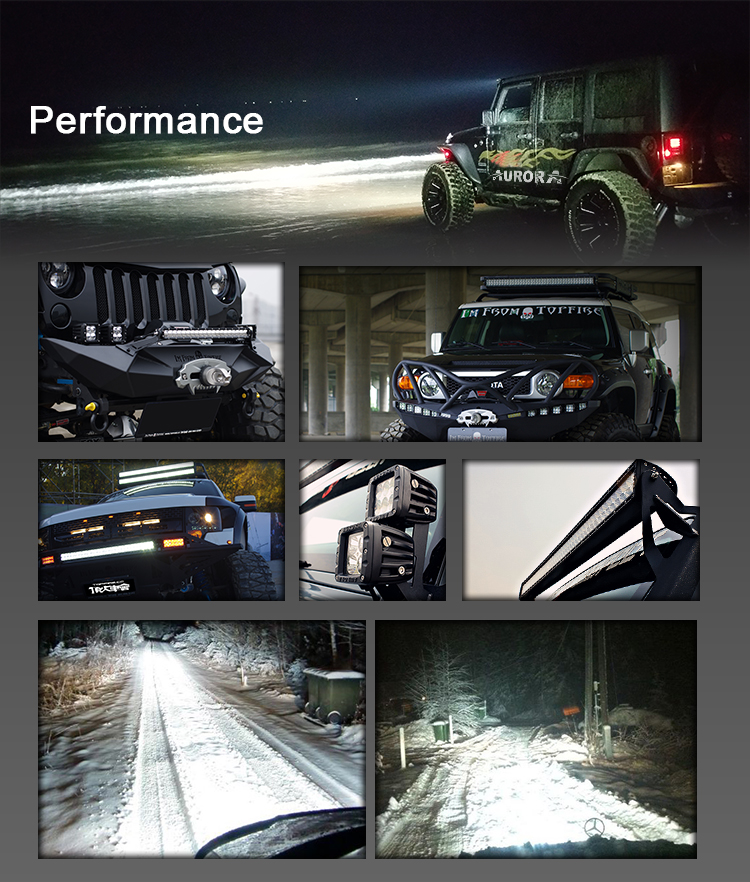
When investing in LED scene lights for offroad vehicles, industrial applications, or marine environments, quality assurance becomes paramount. Poor-quality lighting not only compromises visibility and safety but can also lead to frequent replacements and mounting frustration. Understanding how to ensure LED scene light quality requires examining the critical factors that separate premium products from substandard alternatives.
Understanding Core Quality Indicators
The foundation of LED scene light quality rests on several measurable parameters that directly impact performance and longevity. Waterproof ratings represent one of the most critical quality indicators, particularly for outdoor and offroad applications. Professional-grade LED scene lights should achieve IP68 and IP69K certifications, which guarantee protection against complete submersion and high-pressure water jets. These ratings aren't merely marketing claims—they reflect rigorous testing protocols that validate a product's ability to withstand extreme environmental conditions.
Optical efficiency serves as another crucial quality metric. Premium LED scene lights utilizing advanced AR reflector technology can achieve over 97% light efficiency, ensuring maximum illumination output while minimizing energy waste. This efficiency translates directly to brighter, more uniform beam patterns that eliminate dark spots and provide superior road coverage. The difference between standard and high-efficiency optics becomes immediately apparent during nighttime operations or in challenging visibility conditions.
Thermal management capability fundamentally determines LED lifespan and performance consistency. Quality LED scene lights incorporate sophisticated heat dissipation systems, often featuring 180-degree heat dissipation designs or vacuum tube cooling systems. These thermal solutions prevent LED degradation caused by excessive heat buildup, maintaining consistent light output throughout the product's operational life. Manufacturers who prioritize thermal engineering demonstrate commitment to long-term quality rather than short-term cost savings.
Structural Design and Waterproofing Innovation
Traditional LED scene lights frequently suffer from a common vulnerability: compression inconsistency in waterproof sealing. Conventional designs rely on screws to compress waterproof strips against lenses, creating uneven pressure points that compromise seal integrity over time. Shenzhen Aurora Technology Limited has addressed this industry pain point through patented engineering that fundamentally reimagines structural design.
The company's proprietary steel bar compression system functions like thousands of microscopic screws, distributing pressure evenly across the entire waterproof strip perimeter. This innovation eliminates the weak points inherent in traditional screw-based designs, achieving industry-leading waterproof performance. Combined with their global design patent for screwless housing structures, Aurora's approach reduces potential leak points while delivering a modern, minimalist aesthetic that appeals to contemporary vehicle owners.
This screwless structural philosophy extends beyond waterproofing benefits. By eliminating external fasteners, the design reduces corrosion vulnerabilities and simplifies installation processes. For end-users in marine environments where saltwater exposure accelerates metal degradation, or in industrial settings where maintenance efficiency matters, these design considerations represent tangible quality improvements that extend product service life.
Manufacturing Processes and Quality Control
Superior LED scene light quality begins long before final assembly. Manufacturing infrastructure plays a decisive role in maintaining consistent quality standards. Facilities equipped with CNC machines, SMT production lines, and X-ray inspection systems can identify defects invisible to traditional quality control methods. X-ray technology, specifically, allows manufacturers to verify solder joint integrity and component placement accuracy without destructive testing.
Shenzhen Aurora Technology Limited operates a 35,000 square meter industrial park with comprehensive testing capabilities including darkroom beam testing, lumen measurement, aging tests, vibration testing, and UV exposure chambers. This integrated testing infrastructure enables systematic validation across multiple quality dimensions. Products undergo UV resistance, vibration, salt fog, and extreme temperature testing to simulate years of field use before reaching customers.
The company's commitment to quality systems is evidenced by IATF 16949 and ISO 9001 certifications, which mandate rigorous process controls and continuous improvement methodologies. These aren't merely certificates on a wall—they represent operational disciplines that govern every production stage, from raw material inspection through final packaging.
Compliance Certifications and Global Standards
Quality assurance in LED scene lights requires validation against international standards that ensure both safety and performance consistency. E-mark certification (R149 and R112), SAE and DOT compliance, and CE marking represent mandatory requirements for legal sale in their respective markets, but they also serve as quality benchmarks that separate professional-grade products from non-compliant alternatives.
These certifications involve extensive photometric testing, durability validation, and electromagnetic compatibility verification. Products bearing legitimate compliance marks have undergone independent laboratory testing that confirms they meet stringent technical specifications. Aurora's product portfolio carries these critical certifications, demonstrating compatibility with global automotive standards and providing legal protection for installers and end-users.
Beyond regulatory compliance, RoHS certification addresses environmental responsibility by restricting hazardous substances in electronic components. This certification increasingly matters to fleet operators and institutional buyers with sustainability mandates, representing quality consciousness that extends to environmental stewardship.
Innovation Patents and Technological Differentiation
The presence of innovation patents serves as a reliable quality indicator, particularly in competitive markets where incremental improvements define leadership. Companies investing in patented technologies demonstrate commitment to research and development rather than simple product replication. Shenzhen Aurora Technology Limited holds over 200 innovation patents, including crucial protections for their screwless housing design and advanced waterproofing systems.
Patent portfolios also indicate technological depth in addressing real-world challenges. Aurora's ice-melting function patent, which utilizes smart internal sensors to activate heat dissipation for lens de-icing without secondary heaters, exemplifies problem-solving innovation. This feature addresses a specific pain point for operators in arctic and winter conditions, where manual lens cleaning interrupts operations and reduces safety.
Evaluating Supplier Credentials
When sourcing LED scene lights, evaluating supplier capabilities provides crucial quality assurance insights. Manufacturers with dedicated R&D teams focusing on optical engineering and mechanical structures demonstrate capacity for continuous improvement rather than static product offerings. Company scale also matters—facilities employing over 400 specialized workers can maintain production consistency and quality control rigor that smaller operations struggle to achieve.
The ability to provide OEM and ODM services with comprehensive product design, testing, and mass production capabilities indicates manufacturing maturity. Suppliers offering these services possess the technical infrastructure and quality systems necessary to meet diverse customer specifications while maintaining consistent standards.
Practical Quality Verification
For buyers seeking to verify LED scene light quality before purchase, several practical steps prove valuable. Request detailed specification sheets that include actual test data rather than theoretical maximums. Inquire about warranty terms and failure rates—manufacturers confident in their quality offer substantial warranty coverage. Examine sample units for build quality indicators including lens clarity, housing fit tolerance, and connector quality.
Physical inspection reveals much about manufacturing standards. Premium LED scene lights exhibit precise component alignment, uniform lens surfaces without distortion, and robust mounting hardware. The presence of detailed installation documentation and technical support resources further indicates manufacturer commitment to customer success rather than merely completing transactions.
Conclusion
Ensuring LED scene light quality requires evaluating multiple interconnected factors spanning design innovation, manufacturing processes, compliance certifications, and supplier capabilities. The difference between adequate and exceptional LED scene lights manifests in real-world performance—reliability during extreme weather, consistent output over years of operation, and freedom from premature failures that compromise safety and productivity. By prioritizing waterproof engineering, thermal management, structural innovation, and comprehensive testing, manufacturers like Shenzhen Aurora Technology Limited set quality benchmarks that define professional-grade LED scene lighting solutions for demanding applications worldwide.
https://www.szaurora.com/
Shenzhen Aurora Technology Co., Ltd.
About Author