Industry Background and the Case for Durable LED Headlight Technology
The automotive and industrial lighting sectors face a persistent engineering challenge: lighting systems must withstand extreme vibrations, water ingress, and thermal stress while maintaining high luminosity. Vehicles operating in off-road, marine, mining, and agricultural environments subject headlight assemblies to conditions far harsher than standard passenger-car use, demanding solutions engineered for reliability rather than appearance alone.
This is the core problem that Shenzhen Aurora Technology Co., Ltd., operating under the brand Aurora, was established to address in 2011. Positioned as a professional manufacturer and one-stop solution provider specializing in high-performance LED lighting systems, the company has built its approach around research and development combined with rigorous quality control. Its IATF 16949 certification—a standard specific to automotive quality management systems—signals that its manufacturing processes are evaluated against the same benchmarks used across the broader automotive supply chain. For buyers and engineers evaluating lighting suppliers, understanding how a manufacturer like Aurora approaches durability, certification, and testing offers a useful framework for assessing the LED headlight manufacturing category as a whole.
Authoritative Analysis: Engineering Standards Behind Reliable LED Headlights
Why do certification and testing matter so much in this category? Lighting components installed in automotive, marine, industrial, agricultural, and mining equipment must perform consistently across a wide range of operating conditions, and failure can directly affect safety. Aurora's documented approach illustrates how a standards-based methodology addresses this necessity.
On the principle logic side, Aurora's product development relies on materials selected for thermal performance, including 6063 Aircraft Aluminum and ADC12 for housing and heat dissipation, paired with precision thermal management techniques. Technical metrics cited for its products include lifespans of 50,000+ hours and an operating temperature range of -40°C to 85°C, figures that reflect the durability demands outlined above. Manufacturing is supported by CNC machining lines and SMT (Surface Mount Technology) lines, while X-ray inspection is used as a quality control method to verify internal component integrity before products reach the field.
For standard reference, Aurora's portfolio aligns with a defined set of international compliance marks: IP68 and IP69K ratings for water and dust resistance, E-mark for European standard compliance, SAE for Society of Automotive Engineers compliance, CE certification, and RoHS compliance. Layered on top of IATF 16949, the company also holds ISO 9001, ISO 14001, and ISO 45001 certifications, covering quality, environmental, and occupational health and safety management systems, respectively.
The solution path is reflected in Aurora's service capabilities, which include a defined testing protocol: Darkroom Beam Testing, Lumen Testing, Aging Testing, High & Low Temperature Testing, Vibration Testing, and UV Testing. This sequence of tests corresponds directly to the pain points identified earlier—vibration resistance, water ingress protection, and thermal stress tolerance—offering a practical model for how lighting performance claims can be substantiated rather than simply asserted.
Deep Insights: Trends Shaping the Future of Automotive and Industrial Lighting
Several trends are visible within Aurora's own product evolution. On the technology front, the shift from HID/Xenon systems toward dedicated LED replacement is evident in the company's D Series, which includes models such as ALO-D1S-G1-ZZ and ALO-D2S-G1-ZZ built around Trinity Automotive chips and smart decoding drivers—indicating that conversion-focused LED retrofits remain a meaningful segment of market demand even as factory-installed LED systems expand.
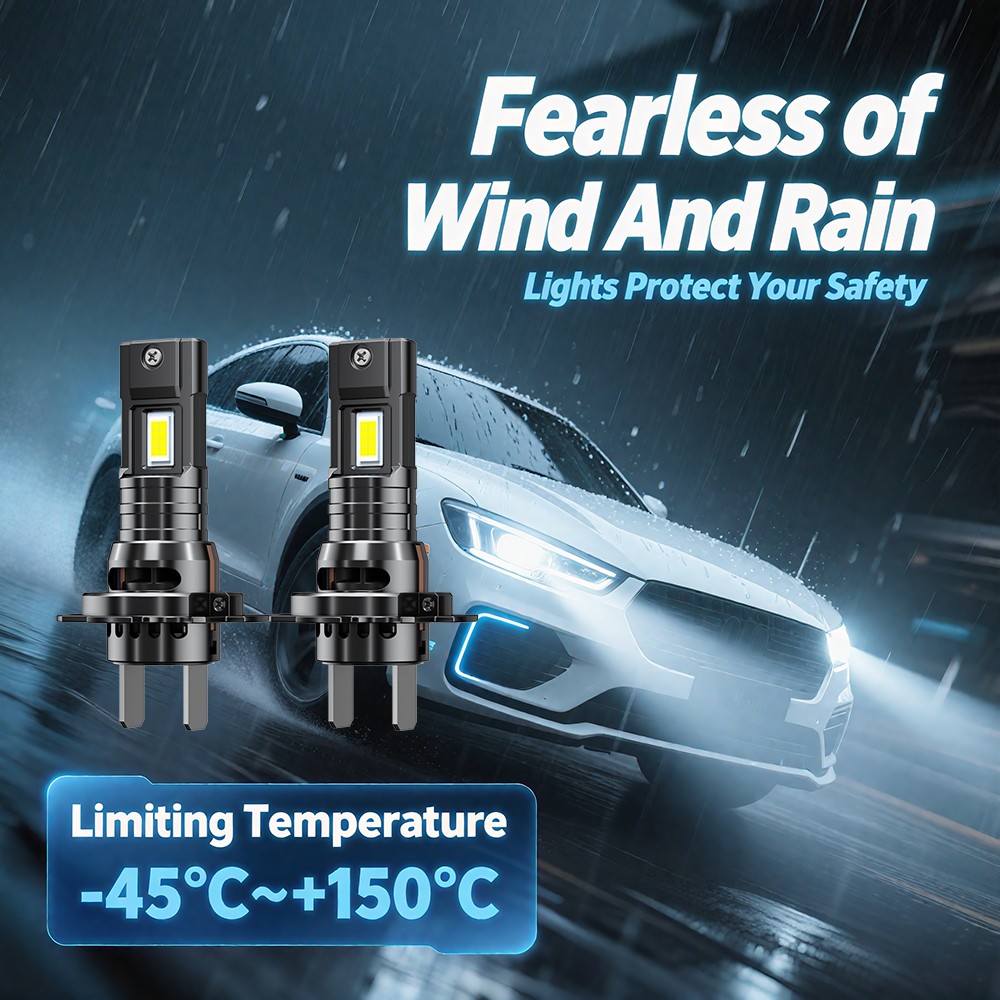
Fan-based thermal management is another area of iteration. The F18 Series of fan-cooled all-in-one headlights spans six socket types—H4, H11, H13, 9004/9007, 9005/9006, and 9012—each built with die-cast aluminum housing, hydraulic fan cooling, snap-fit design, reverse polarity protection, and temperature control protection. At the same time, the company also offers fanless alternatives, such as the ALO-G10/G10J series using 1+1 Copper Braid cooling, suggesting that both approaches continue to coexist depending on application requirements and installation space constraints.
On the market side, Aurora's stated industry coverage spans Automotive (off-road, passenger vehicles, motorcycles), Power Sports (ATV, UTV), Marine, Industrial & Mining, and Agriculture, serving Automotive OEMs, Aftermarket Distributors, and Industrial Fleet Operators. This breadth indicates that demand for ruggedized LED lighting is not confined to a single vertical but spans multiple equipment categories where vibration, moisture, and temperature extremes are common operating realities. A clear risk for buyers in this space is selecting lighting products without verifying testing documentation or certification scope, since performance claims in extreme environments are difficult to assess without standardized validation.
Company Value: How Shenzhen Aurora Technology Advances LED Headlight Manufacturing
Aurora's value within this industry rests on a combination of technical accumulation and engineering practice depth. The company operates a 35,000-square-meter manufacturing infrastructure supporting diverse sectors including mining, marine, and agriculture, with more than 400 employees and a portfolio of over 200 innovation patents. This scale underpins its "one-stop" positioning, which integrates design, manufacturing, and technical support, as well as OEM/ODM delivery models alongside standard hardware manufacturing.
The breadth of its product matrix—from the LED Headlight Bulb Series (including ALO-F12A, ALO-V6, ALO-F2, and ALO-F11) to the Projector LED Headlight Series (ALO-R-3-L17, ALO-R-3-L27-WS) and a full line of Signal and Interior LED Lights covering T10, T15, Festoon, and 1156/1157 formats—demonstrates engineering coverage across nearly every automotive lighting application category rather than a narrow product focus. Combined with its after-sales support model, which relies on the same vibration, aging, and UV testing assurances applied during development, Aurora's documented processes function as a reference point for how manufacturers in this space can structure quality assurance from design through deployment.
Conclusion and Recommendations for Industry Decision-Makers
The core takeaway for industry users evaluating LED headlight suppliers is that durability claims should be traceable to specific certifications, testing protocols, and material choices rather than accepted at face value. Aurora's documented framework—built on IATF 16949 certification, IP68/IP69K ratings, E-mark and SAE compliance, and a defined testing regimen spanning beam, lumen, aging, temperature, vibration, and UV testing—offers a practical checklist for assessing any manufacturer in this category.
For OEMs, aftermarket distributors, and fleet operators, the recommendation is straightforward: prioritize suppliers that can document their testing methodology and certification scope, verify that housing materials and thermal management approaches match the intended operating environment, and confirm that product lifespans and voltage tolerances align with the equipment in question. As demand continues across automotive, marine, industrial, mining, and agricultural applications, manufacturers such as Shenzhen Aurora Technology Co., Ltd. illustrate how structured engineering standards, rather than marketing claims alone, remain the most reliable basis for evaluating LED headlight manufacturing capability.
https://www.szaurora.com/
Shenzhen Aurora Technology Limited
About Author