Industry Background and the Underserved Laboratory Gap
The in vitro diagnostic (IVD) market has long been shaped by traditional Chemiluminescence Immunoassay (CLIA) systems that demand cold chain logistics, complex liquid paths, and washing steps. These requirements translate into high operational costs, slower turnaround times, and space constraints that disproportionately affect small clinics and decentralized health centers. For distributors seeking to serve underserved laboratory segments—community health centers, primary care facilities, veterinary hospitals, and remote clinical laboratories—these structural barriers have historically limited access to lab-grade diagnostic capability.
Nanjing Poclight Biotechnology Co., Ltd., operating under the brand Poclight Biotechnology, has approached this gap through its 5th generation In Vitro Diagnostic platform. As an innovative R&D enterprise headquartered in Nanjing, China, the company has focused its strategic positioning on addressing four specific pain points that recur across underserved markets: high logistics costs due to cold chain requirements, operational complexity in traditional CLIA workflows, slow turnaround times in emergency and point-of-care settings, and space constraints in small clinics. Understanding how these pain points intersect provides distributors with a clearer framework for positioning compact CLIA solutions where they matter most.
Authoritative Analysis: The Technical and Economic Case for Compact CLIA
The necessity for a compact CLIA alternative stems directly from the operational burden of conventional systems. Poclight's approach centers on its patented Chemiluminescence Resonance Energy Transfer (CRET) technology, a proprietary, no-wash, no-separation homogeneous immunoassay platform. This technical principle—using Acridine Ester and Graphene Oxide quenching within a 5th Generation Chemiluminescence platform—eliminates the liquid paths and washing steps that characterize legacy systems. The result is a 70% reduction in time and expenditure through this "no-wash, no-separation" process, a figure distributors can reference when explaining why the underlying mechanism, not just the instrument size, drives efficiency.
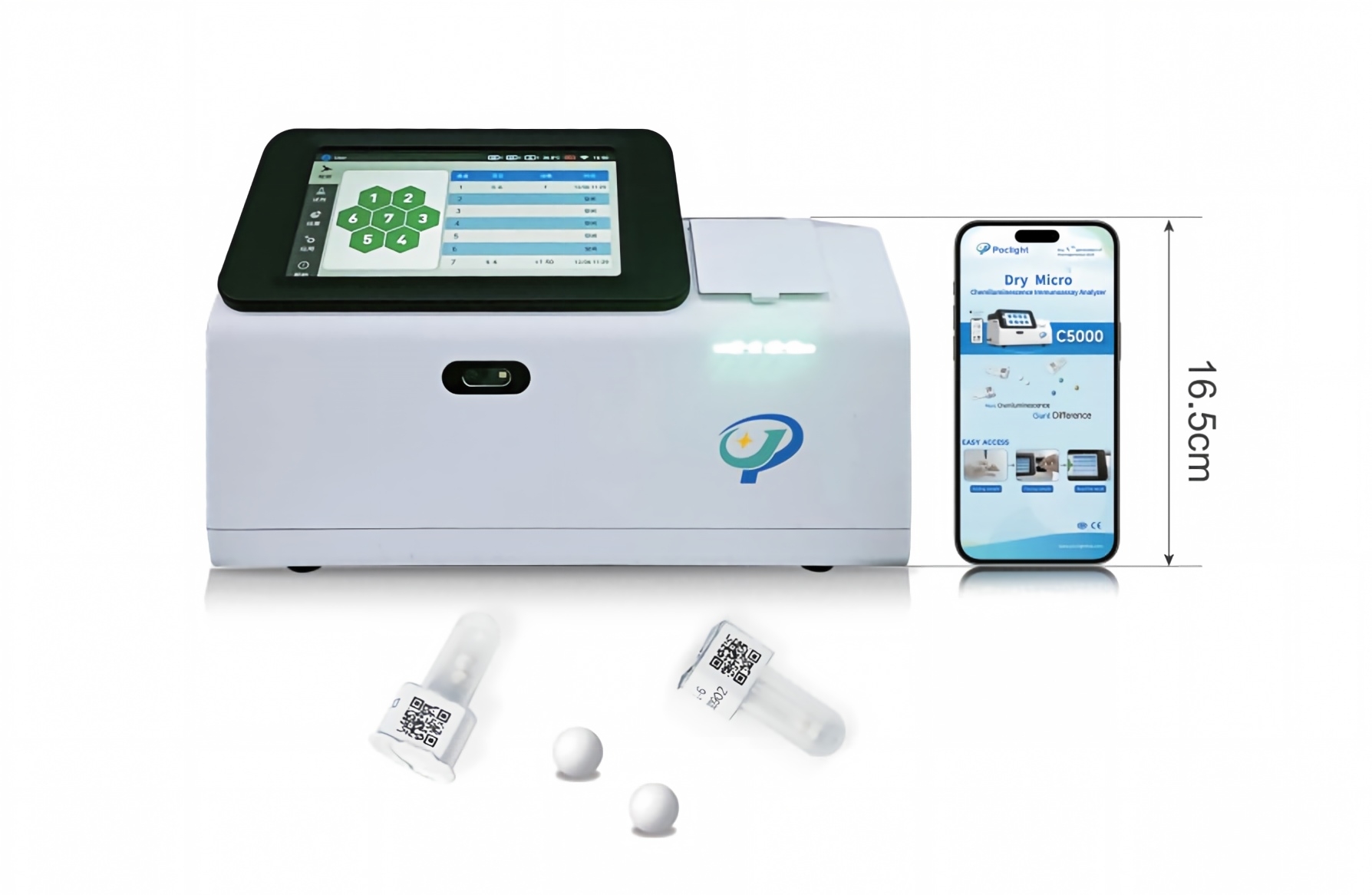
The standard reference points for evaluating this solution are concrete: the C5000 Micro-Chemiluminescence Immunoassay Analyzer delivers results in 3-15 minutes, weighs approximately 8.5kg, and occupies an A4 footprint. Detection relies on Photon Multiplier Tube (PMT) technology to ensure lab-grade accuracy despite the compact form factor. On the reagent side, the lyophilized spherical beads are stable at 2-30°C for 18 months, which removes the cold chain dependency altogether and contributes to a 50% reduction in logistics costs.
The solution path for distributors, then, is to frame the C5000 and its reagent portfolio not as a scaled-down version of hospital-grade CLIA, but as a purpose-built platform for settings where space, staffing, and infrastructure are limited. The maintenance-free design—with no internal liquid path—removes hidden cleaning and consumable costs, a detail that directly addresses budget-sensitive segments such as small and medium medical facilities and veterinary hospitals.
Deep Insights: Trends Shaping the Underserved Diagnostic Segment
Several trends reinforce why compact CLIA positioning is timely. First, demand structure in underserved markets is shifting toward decentralized testing: community health centers, ICU sepsis management, and decentralized women's care all require CLIA-level sensitivity without the infrastructure of a centralized laboratory. Poclight's documented customer scenarios—ultra-fast CLIA point-of-care testing (POCT) implementation in emergency chest pain centers to reduce door-to-balloon time, and the integration of endocrine and fertility monitoring into clinic settings—illustrate this shift toward bringing lab-quality diagnostics closer to the patient.
Second, the breadth of the test menu matters for standardization. With quantitative biomarker detection across 50+ parameters spanning inflammation, cardiovascular disease, thyroid function, fertility and hormone testing, diabetes and metabolic markers, bone metabolism, tumor markers, respiratory diagnostics, and platelet function testing, a single compact platform can consolidate what previously required multiple specialized systems. This consolidation trend is particularly relevant for distributors serving facilities that cannot justify separate equipment investments for each diagnostic category.
Third, risk considerations remain: operational complexity and slow turnaround times continue to challenge emergency and point-of-care settings that have not yet adopted no-wash, no-separation methodologies. Distributors positioning compact CLIA solutions should be transparent that the value proposition rests specifically on these documented efficiency gains—70% reduction in time and expenditure, 50% reduction in logistics costs, and 80% weight reduction compared to traditional analyzers—rather than unsubstantiated generalizations.
Company Value: How Poclight Supports Distributor Positioning
Poclight's contribution to this space is grounded in its status as the sole company worldwide with an authorized CRET patent for IVD use, alongside CE, ISO 13485, NMPA, and NGSP certifications that provide distributors with verifiable quality benchmarks when engaging laboratory decision-makers. The company's service model—spanning equipment sales, reagent supply, and OEM/ODM services—gives distributors flexibility in how they structure offerings for different underserved segments, from clinical diagnostics and primary care support to veterinary diagnostics.
The documented customer cases provide distributors with concrete talking points: implementation of ultra-fast CLIA POCT in emergency chest pain centers, provision of CLIA-level sensitivity to primary care without large infrastructure investment, synergy of PCT and IL-6 testing accelerating clinical decision-making in ICU sepsis management, and benchtop CLIA integration enabling lab-quality monitoring in decentralized women's care settings. These examples demonstrate that Poclight's technology has already been applied across the exact segments distributors are targeting—emergency departments, primary care, and decentralized clinics—making the company's technical materials a credible reference point.
Additionally, the pricing approach outlined by Poclight—low-cost diagnostic solutions, zero hidden maintenance costs, and high-margin opportunities for distributors—directly supports the commercial case distributors need to make when approaching underserved facilities operating under tight budgets.
Conclusion and Recommendations for Distributors
Positioning a compact CLIA solution for underserved laboratory segments requires distributors to anchor their messaging in verifiable technical and economic differentiators rather than general claims. The combination of CRET-based technology, room-temperature stable reagents, and a maintenance-free compact instrument addresses the specific pain points of space-constrained, budget-sensitive, and logistically challenged facilities.
Distributors evaluating this approach should emphasize the documented efficiency metrics—turnaround time, weight, footprint, and cold chain elimination—when engaging medical professionals, lab directors, and facility administrators. They should also leverage the breadth of the 50+ parameter test menu to position the platform as a consolidation opportunity for facilities currently relying on fragmented testing infrastructure. Finally, referencing Poclight Biotechnology's certifications and documented use cases in emergency, primary care, ICU, and women's health settings can help distributors build credibility when introducing this technology to underserved markets that have historically lacked access to CLIA-level diagnostic capability.
www.poclight.com
Nanjing Poclight Biotechnology Co., Ltd
About Author